Chinese EGFR and MET Targeted Therapies in NSCLC: Rilertinib, Iruplinal, Rezivertinib and Savolitinib

Chinese EGFR and MET Targeted Therapies in Non-Small Cell Lung Cancer
In recent years, with the rapid development of precision medicine in lung cancer, targeted therapy has become a core strategy in the treatment of non-small cell lung cancer (NSCLC). Chinese pharmaceutical innovation has also made continuous breakthroughs in this field, gradually forming multiple technological pathways.
Among the drugs that have attracted significant attention in recent years are Rilertinib Mesylate Tablets, Iruplinal Capsules (Citrate), Rezivertinib Mesylate Capsules, and Savolitinib Tablets. These four agents represent different development directions in EGFR and MET targeted therapies.
Against the backdrop of an increasingly integrated global innovative drug supply chain, professional pharmaceutical supply service providers—including
Hong Kong DengYue Pharmaceutical—are paying growing attention to innovative targeted therapies developed in China and helping promote their compliant circulation and clinical accessibility in international markets.
Why EGFR / MET Targeted Therapy Continues to Attract Attention
In non-small cell lung cancer, EGFR mutations and MET abnormalities are two important driver gene alterations.
EGFR mutations account for approximately 40–50% of NSCLC cases in Asian patients. EGFR inhibitors can effectively block tumor cell signaling pathways and inhibit tumor growth.
Abnormalities in the MET signaling pathway—such as MET exon 14 skipping mutations or MET amplification—can promote tumor cell proliferation, migration, and drug resistance, making MET one of the key research focuses in recent targeted therapy development.
The primary mechanisms of EGFR/MET targeted therapies include:
- Inhibiting activation of tumor cell signaling pathways
- Blocking tumor cell proliferation and metastasis
- Delaying tumor progression
- Improving patients’ progression-free survival (PFS)
With the increasing availability of precision diagnostic technologies, molecular subtype-guided therapy is becoming an important trend in lung cancer treatment.
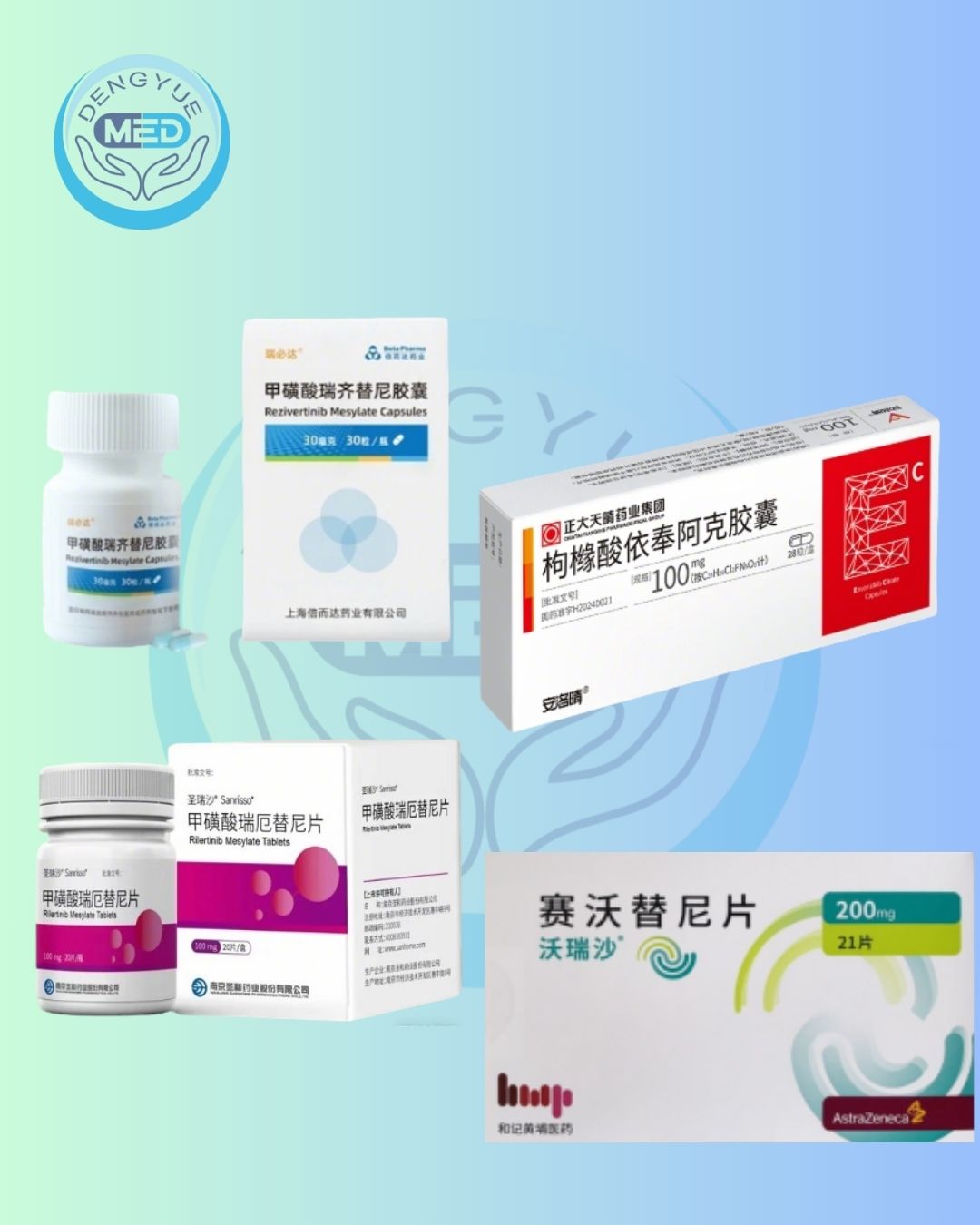
Key Chinese Innovative Targeted Drugs
1. Rilertinib Mesylate Tablets
Drug type: Third-generation EGFR tyrosine kinase inhibitor (TKI)
Development focus: EGFR-mutated non-small cell lung cancer
Mechanism
Rilertinib selectively inhibits mutant EGFR receptors, blocking downstream tumor signaling pathways and thereby suppressing tumor cell proliferation.
The drug is designed to effectively target common EGFR-sensitive mutations while minimizing inhibition of wild-type EGFR.
Key features
✔ Targets EGFR mutation signaling pathways
✔ Oral small-molecule TKI therapy
✔ Helps delay tumor progression
✔ Supports precision molecular classification treatment
Rilertinib represents an important step in the continued advancement of domestically developed EGFR-targeted therapies in China.
2. Iruplinal Capsules (Citrate)
Drug type: EGFR Exon20 insertion mutation inhibitor
Indication focus: NSCLC with EGFR Exon20 insertion mutations
Mechanism
EGFR exon 20 insertion mutations are relatively rare but difficult-to-treat mutations that often show limited sensitivity to earlier EGFR-TKIs.
Iruplinal is structurally optimized to target this specific mutation configuration, enabling inhibition of abnormal EGFR kinase activity.
Potential advantages
✔ Specifically designed for EGFR Exon20 insertion mutations
✔ Oral small-molecule targeted therapy
✔ Provides treatment options for rare mutation populations
✔ High value in precision oncology
Iruplinal reflects the development trend of targeted therapies moving toward precision treatment for rare mutations.
3. Rezivertinib Mesylate Capsules
Drug type: Third-generation EGFR tyrosine kinase inhibitor
Development positioning: EGFR-mutated non-small cell lung cancer
Mechanism
Rezivertinib irreversibly binds to mutant EGFR receptors, blocking downstream signaling pathways and inhibiting tumor cell growth.
The design focuses on improving selectivity for EGFR-mutant tumors while reducing inhibition of normal EGFR.
Potential advantages
✔ Third-generation EGFR targeted therapy
✔ Oral administration for treatment convenience
✔ Active against EGFR-sensitive mutations
✔ Supports precision molecular subtype treatment
Rezivertinib is considered an important domestic representative of third-generation EGFR-TKIs in China.
4. Savolitinib Tablets
Drug type: MET tyrosine kinase inhibitor
Primary indication: NSCLC with MET exon 14 skipping mutation
Mechanism
The MET signaling pathway plays a key role in tumor growth, invasion, and metastasis.
Savolitinib selectively inhibits MET kinase activity, blocking abnormal signaling and suppressing tumor cell proliferation.
Potential advantages
✔ Targets MET-driven mutations
✔ Provides therapy for METex14 mutation patients
✔ Oral small-molecule targeted drug
✔ Important component of precision oncology
Savolitinib represents a significant breakthrough in MET-targeted therapy for lung cancer.
Industry Trend Observations
From the development pathways of these four drugs, several trends in China’s lung cancer targeted therapy landscape can be observed:
Increasingly refined molecular subtyping
Treatment strategies are expanding from common EGFR mutations to more specific subtypes such as Exon20 and MET alterations.
Growth of domestic innovative drugs
Chinese pharmaceutical companies continue strengthening their capabilities in small-molecule targeted drug development.
Drug resistance mechanisms becoming a research focus
New therapies are increasingly designed to address resistance mutations.
Integration of precision diagnostics and targeted therapy
Molecular testing has become a key foundation for clinical treatment decisions in lung cancer.
During this process, pharmaceutical supply chain companies—including
Hong Kong DengYue Pharmaceutical—are helping improve global access to innovative targeted therapies through international sourcing networks, compliant distribution systems, and pharmaceutical logistics capabilities.
Conclusion
Overall, Rilertinib, Iruplinal, Rezivertinib, and Savolitinib represent several important development directions in China’s lung cancer targeted therapy field:
- Continuous optimization of third-generation EGFR inhibitors
- Emergence of therapies targeting rare EGFR mutations
- Maturation of MET-targeted therapies
- Precision medicine becoming the central treatment paradigm
As more clinical data are generated and international collaboration expands, Chinese innovative targeted therapies are expected to play an increasingly important role in the global lung cancer treatment landscape.
Meanwhile, professional pharmaceutical supply service providers—including
Hong Kong DengYue Pharmaceutical—are also expected to play a more significant role in bridging Chinese innovative medicines with global clinical needs.