7-Minute Immunotherapy Infusion! Atezolizumab Subcutaneous Injection Approved in China
In recent years, tumor immunotherapy has continued to develop rapidly, and PD-1/PD-L1 inhibitors have become important treatment options for multiple malignancies such as lung cancer, liver cancer, and breast cancer. As cancer treatment enters the stage of long-term and chronic disease management, patients’ demand for “treatment convenience” is also increasing.
Recently, the subcutaneous injection formulation of Atezolizumab was approved for marketing in China, attracting widespread industry attention. Compared with the traditional intravenous infusion method, the biggest highlight of this new formulation is that administration can be completed in only about 7 minutes.
This change also means that PD-L1 immunotherapy is gradually moving from the “long infusion era” toward the “rapid subcutaneous injection era.”
As an industry participant continuously following the development of global cancer immunotherapy, DengYueMed is also closely tracking innovative therapies and the latest clinical research developments. So, what are the characteristics of the Atezolizumab subcutaneous injection? And how does it differ from traditional intravenous administration?
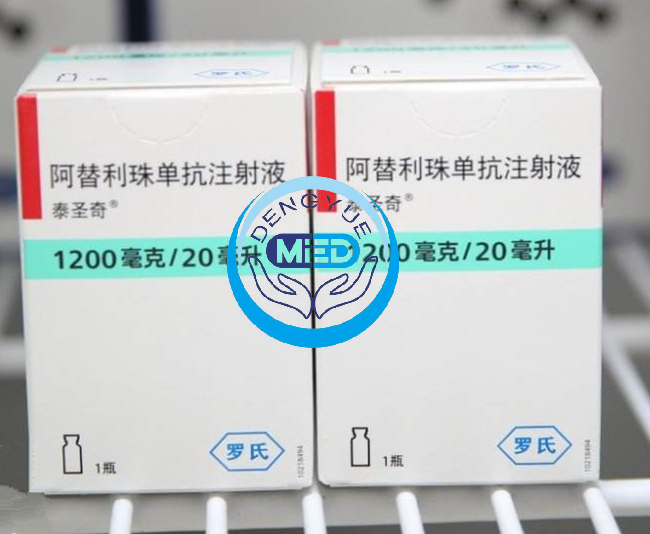
What Is Atezolizumab?
Atezolizumab is a PD-L1 inhibitor developed by Roche. Its mechanism of action mainly involves blocking the binding of PD-L1 to PD-1, thereby reactivating the anti-tumor activity of T cells.
Currently, Atezolizumab has been widely used in multiple cancer types, including:
- Non-small cell lung cancer (NSCLC)
- Small cell lung cancer (SCLC)
- Hepatocellular carcinoma
- Triple-negative breast cancer
- Urothelial carcinoma
Globally, Atezolizumab has become one of the important PD-L1 immunotherapy drugs.
What Are the Differences Between Atezolizumab Subcutaneous Injection and Intravenous Infusion?
One of the biggest concerns for many patients is: does subcutaneous injection mean reduced efficacy?
In fact, current studies show that the core active ingredient in the subcutaneous formulation remains Atezolizumab, and its anti-tumor mechanism has not changed. The real differences mainly lie in:
- Administration method
- Administration time
- Treatment convenience
- Patient experience
The main differences are as follows:
| Comparison Item | Atezolizumab Intravenous Infusion | Atezolizumab Subcutaneous Injection |
|---|---|---|
| Administration Method | Intravenous infusion | Subcutaneous injection |
| Administration Time | Usually 30–60 minutes | About 7 minutes |
| Need for Infusion Equipment | Required | Usually not required |
| Outpatient Stay Time | Longer | Shorter |
| Patient Convenience | Moderate | Higher |
| Long-Term Treatment Experience | More cumbersome | More patient-friendly |
| Medical Resource Utilization | Higher | Relatively lower |
| Suitable for Long-Term Maintenance Therapy | Yes | More advantageous |
Therefore, the core value of subcutaneous injection is not “stronger efficacy,” but rather improved treatment efficiency and patient convenience.
Why Is “7-Minute Administration” So Important?
For many patients, immunotherapy often continues for months or even years. In the past, each treatment session could involve:
- Waiting in line
- Intravenous infusion
- Long waiting times
- Monitoring for adverse reactions
With the introduction of subcutaneous injection formulations, the entire treatment process is expected to become significantly simpler.
Especially for:
- Elderly patients
- Frail patients
- Patients receiving long-term maintenance therapy
- Busy working individuals
Rapid administration can significantly reduce the treatment burden.
From the hospital’s perspective, subcutaneous injection may also help:
- Improve outpatient efficiency
- Relieve pressure on infusion centers
- Optimize medical resource allocation
Therefore, subcutaneous PD-L1 therapies may not only improve patient experience, but also influence future cancer treatment models.
Will Subcutaneous PD-L1 Therapy Become a Future Trend?
In recent years, a clear trend has emerged in global cancer immunotherapy: competition is gradually shifting from “efficacy alone” to “efficacy plus convenience.”
More and more companies are now developing:
- Subcutaneous PD-1/PD-L1 therapies
- Long-acting formulations
- Home administration models
- Subcutaneous bispecific antibodies
The reason is that as patient survival continues to improve, long-term treatment experience is becoming increasingly important.
Compared with traditional intravenous infusion, subcutaneous injection offers multiple advantages, including:
- Faster administration
- Greater convenience
- Better time efficiency
- More suitable for long-term management
The approval of the Atezolizumab subcutaneous injection in China also indicates that China’s cancer immunotherapy field is becoming increasingly aligned with global development trends.
Which Patients May Be More Suitable for Subcutaneous Injection?
Although subcutaneous injection offers clear advantages, it does not mean that every patient must switch formulations.
Generally speaking, the following groups may be more suitable:
- Patients receiving long-term maintenance therapy
- Patients who have difficulty undergoing frequent infusions
- Elderly patients
- Patients with poor venous access
- Patients hoping to reduce hospital stay time
However, the specific treatment plan still requires individualized evaluation by physicians based on tumor type, disease stage, physical condition, and combination therapy regimens.
Conclusion
The approval of the Atezolizumab subcutaneous injection in China not only represents a further upgrade in PD-L1 immunotherapy formulations, but also marks the continued shift of cancer treatment toward greater convenience and efficiency. Compared with traditional intravenous infusion, subcutaneous administration is faster, more patient-friendly, and more convenient for long-term treatment.
Although the core anti-tumor mechanism has not changed, the ability to complete administration in “7 minutes” reflects the ongoing evolution of the entire cancer treatment model. In the future, as more subcutaneous immunotherapy drugs become available, cancer patients may truly enter a more efficient and convenient “post-infusion era.”
Related Posts
- A New Option in Targeted Biologic Therapy: Clinical Insights into Guselkumab Injection
- Chinese HER2 Bispecific Antibody + PD-1 Combination Approved in the U.S. for Gastroesophageal Adenocarcinoma, Advancing to the Forefront of Global Oncology
- The 30-Year Chemotherapy Standard Faces a New Challenge: China's PD-1 Serplulimab Breaks New Ground in Gastric Cancer Treatment