Next-Generation MS Therapy Competition: BTK Inhibitors Are Reshaping the Landscape

Recently, Bruton’s tyrosine kinase (BTK) inhibitors have continued to advance rapidly in the field of autoimmune diseases, gradually expanding from hematologic malignancy targets toward the central nervous system (CNS) autoimmune disease space.
Global pharmaceutical distributor DengYueMed observes that during 2025–2026, BTK inhibitors achieved key regulatory milestones, including FDA approvals of Rilzabrutinib (Sanofi) for immune thrombocytopenia (ITP) and Remibrutinib (Novartis) for chronic spontaneous urticaria (CSU), marking their entry into the commercial stage of autoimmune diseases.
Against this backdrop, multiple sclerosis (MS) has become the next core competitive frontier.
Significant Unmet Needs in Multiple Sclerosis (MS)
Multiple sclerosis is a chronic inflammatory demyelinating disease caused by abnormal immune-mediated attack on the central nervous system.
Damage to the myelin sheath disrupts nerve signal conduction, leading to motor, visual, sensory, and cognitive impairment, and irreversible disability during disease progression.
In terms of disease burden, the global MS population continues to grow, expected to reach approximately 3.7 million cases by 2030, with the market size approaching USD 50 billion.
Despite continuous therapeutic advancements, significant clinical gaps remain, particularly in progressive disease populations such as non-active secondary progressive MS (nrSPMS).
From a disease evolution perspective, a key challenge lies in its long-term progressive nature: approximately 50% of patients with relapsing-remitting MS (RRMS) transition to secondary progressive MS (SPMS) within 10–15 years, and a substantial proportion ultimately develop non-active SPMS (nrSPMS).
This stage is characterized by:
- Gradual reduction of peripheral inflammatory activity
- Ongoing central neurodegeneration
As a result, this population represents a region where almost no effective disease-modifying therapies are currently available.
Current Therapies Have Entered the Third Generation but Still Face Limitations
MS treatment has evolved through three generations: from injectable therapies such as interferon-beta and glatiramer acetate, to the oral S1PR modulator era, and now to high-efficacy immunotherapies dominated by anti-CD20 monoclonal antibodies.
At present, anti-CD20 therapies have become the main treatment backbone, accounting for more than 60% of the MS treatment market.
While they significantly reduce relapse risk, their mechanism is primarily limited to peripheral B-cell depletion, resulting in certain limitations, including:
- Insufficient control of chronic CNS inflammation
- Limited impact on neurodegenerative progression
Therefore, MS treatment is gradually shifting from relapse control toward neuroprotection and disease progression delay, and BTK inhibitors have become a key variable in this transition.
Mechanistic Advantages of BTK Inhibitors: From Peripheral Immunity to CNS Modulation
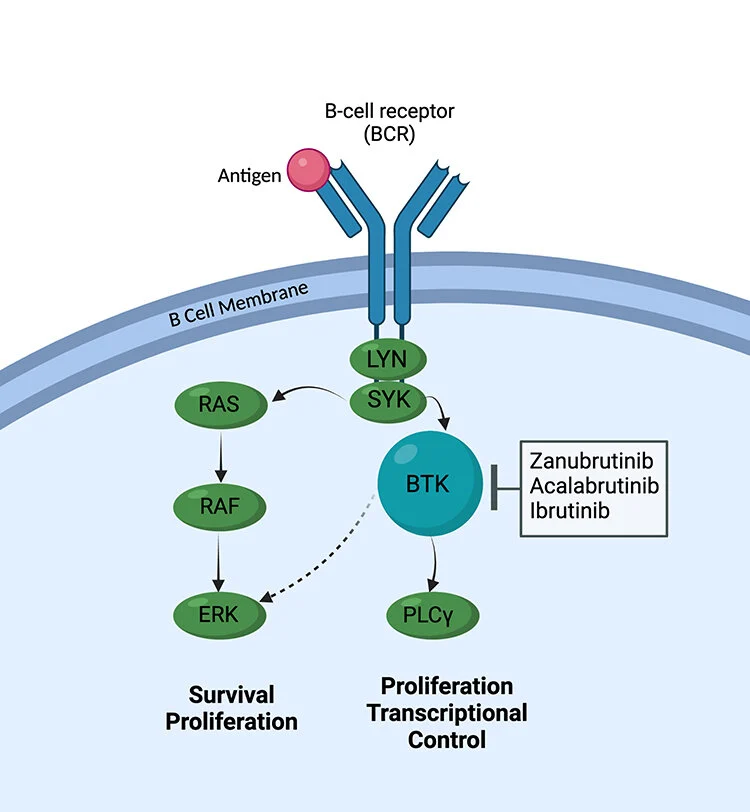
BTK (Bruton’s tyrosine kinase) is a critical signaling molecule in the B-cell receptor (BCR) pathway, playing a central role in B-cell activation, antibody production, and inflammatory amplification.
In MS, its therapeutic potential is mainly reflected in two aspects:
First, by inhibiting peripheral B-cell activation, BTK inhibitors reduce autoimmune inflammatory responses.
Second, some BTK inhibitors demonstrate blood–brain barrier (BBB) penetration capability, allowing them to act on microglia within the CNS and modulate the local inflammatory microenvironment.
This dual mechanism can be summarized as:
- Peripheral: suppression of immune activation
- Central: regulation of neuroinflammation
As a result, BTK inhibitors are considered to have the potential to slow neurodegenerative progression, which also distinguishes them from CD20 antibodies and S1PR modulators.
2026 Clinical Development Update: Entering a Phase of Divergence
By 2026, clinical outcomes of BTK inhibitors in MS have shifted from uniform expectations to clear stratification.
Tolebrutinib (Sanofi) remains the most advanced candidate and has submitted a New Drug Application (NDA) to the FDA, currently under final review.
In Phase III studies, it demonstrated approximately a 31% reduction in confirmed disability progression in non-relapsing SPMS (nrSPMS), suggesting meaningful potential in slowing neurodegeneration.
However, its clinical performance shows clear divergence:
- No primary endpoints met in RRMS and PPMS
- Clinical benefit primarily concentrated in nrSPMS
As a result, its overall positioning has shifted from a broad MS therapy to a precision candidate for nrSPMS.
In contrast, Fenebrutinib (Roche/Genentech) has emerged as the most breakthrough asset, achieving primary endpoints in both RRMS and PPMS Phase III studies.
It demonstrates more comprehensive disease control and, notably, shows clear neuroprotective signals in PPMS, making it the closest candidate to a best-in-class BTK inhibitor.
Remibrutinib (Novartis) continues to focus on RRMS, with Phase III data showing reductions in relapse rate and MRI lesion burden, positioning it as a primarily inflammation-targeted oral therapy.
In addition, Orelabrutinib (InnoCare Pharma) is advancing global Phase III studies, showing potential inhibition of CNS inflammatory lesions in both SPMS and PPMS, representing an important contribution from Chinese biopharmaceutical companies in this field.
Conclusion: MS Therapy Is Entering the Neurodegeneration Competition Era
Overall, BTK inhibitors are driving a fundamental shift in the treatment paradigm of multiple sclerosis.
Therapeutic focus is gradually moving from simple relapse and inflammation control toward:
- Whether CNS disease mechanisms can be directly targeted
- Whether neurodegeneration can be effectively delayed
- Whether unmet needs in nrSPMS can be addressed
With Fenebrutinib achieving dual-indication success and Tolebrutinib progressing in nrSPMS, the clinical value of BTK inhibitors is becoming increasingly defined.
Multiple sclerosis is thus entering a true era of disease-modifying therapeutic transformation.
DengYueMed will continue to monitor global developments in BTK inhibitors and related innovative therapies, providing ongoing insights into research progress and supply-chain perspectives across the pharmaceutical industry.
Related Posts
- Mirdametinib vs Selumetinib: Which MEK Inhibitor Is Better for Neurofibromatosis Type 1 (NF1)?
- From Frequent Management to Long-Acting Treatment: How Plozasiran's Three-Month Dosing Is Changing FCS Care
- China's First Generic Tiotropium Bromide and Olodaterol Inhalation Spray Approved: Ending an 8-Year Market Exclusivity and Bringing New Options for COPD Treatment