Finerenone Approved for a New Indication in China: 18% Reduction in Heart Failure Events and New Progress in HFpEF Treatment
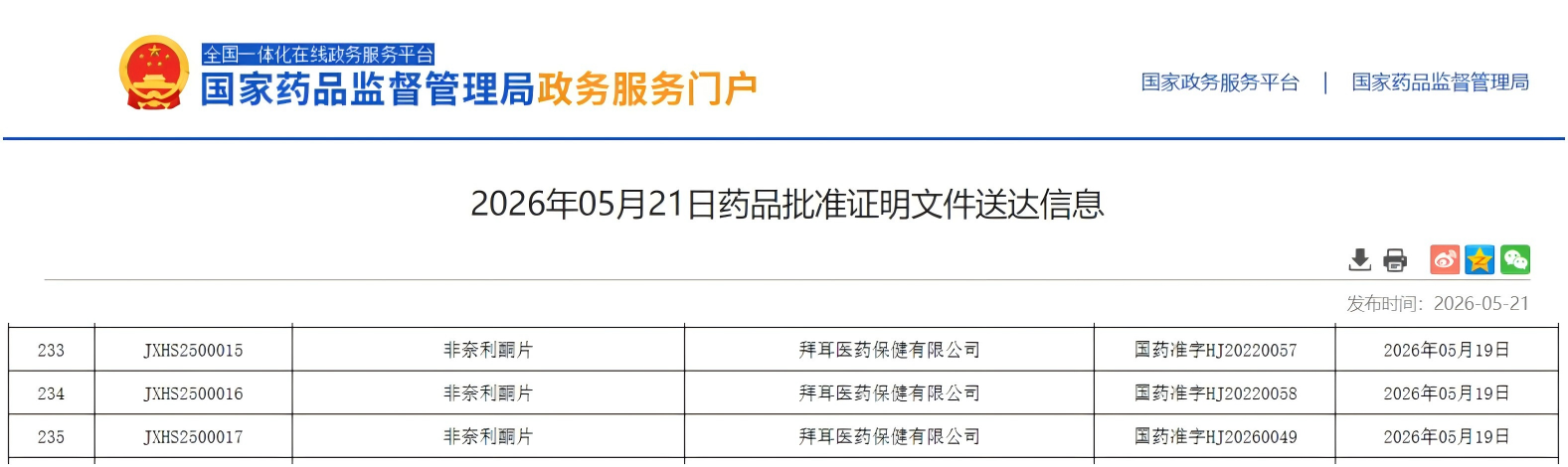
On May 21, 2026, German pharmaceutical company Bayer announced that its innovative drug Finerenone (Kerendia) has been officially approved by the China National Medical Products Administration (NMPA) for use in adult patients with heart failure and a left ventricular ejection fraction (LVEF) ≥40%.
This approval means that Finerenone has formally entered the treatment landscape for heart failure with preserved or mildly reduced ejection fraction (HFpEF/HFmrEF), with the potential to reduce:
- Cardiovascular death risk
- Heart failure hospitalization risk
- Emergency visits due to heart failure
This represents a significant recent advancement in the field of heart failure treatment. China pharmaceutical wholesaler DengYueMed will continue to monitor important therapeutic developments in cardiovascular, renal, and metabolic diseases.
What is Finerenone?
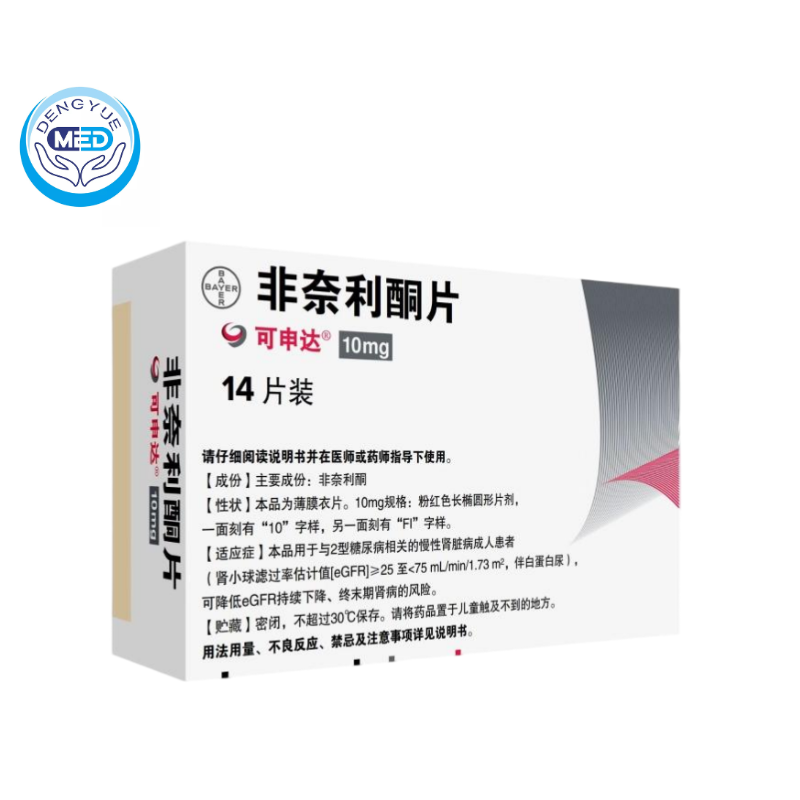
Finerenone is a highly selective, non-steroidal mineralocorticoid receptor antagonist (MRA).
Compared with traditional steroidal MRAs, Finerenone has more precise receptor binding properties and acts on aldosterone-mediated inflammatory and fibrotic pathways, thereby:
- Reducing myocardial fibrosis
- Inhibiting cardiac remodeling
- Reducing renal injury
- Improving the progression of cardiorenal metabolic diseases
Previously, Finerenone had already been approved in China for:
- Type 2 diabetes-associated chronic kidney disease (CKD)
This new heart failure indication further strengthens its position in the integrated “cardio-renal-metabolic” disease management landscape.
FINEARTS-HF Study: A Landmark Positive Trial in Non-steroidal MRA in Nearly 20 Years
The approval in China was primarily based on the global Phase III pivotal study: FINEARTS-HF.
This study enrolled more than 6,000 patients with LVEF ≥40% heart failure, with a median follow-up of 32 months.
1. 16% Reduction in Primary Composite Endpoint
Finerenone group:
- 3,003 patients
- 624 patients experienced 1,083 primary endpoint events
Placebo group:
- 2,998 patients
- 719 patients experienced 1,283 primary endpoint events
Results:
- Hazard ratio (HR) = 0.84
- 95% CI: 0.74–0.95
- P = 0.007
This indicates that Finerenone significantly reduced the composite risk of total heart failure events and cardiovascular death by 16%.
2. 18% Reduction in Total Heart Failure Events
In the study:
- Finerenone group: 842 worsening heart failure events
- Placebo group: 1,024 events
Results:
- HR = 0.82
- 95% CI: 0.71–0.94
- P = 0.006
This shows that Finerenone significantly reduced:
- Heart failure hospitalization
- Acute decompensation
- Emergency medical visits
Overall, total heart failure events were reduced by 18%.
3. Cardiovascular Mortality
Cardiovascular death rates in the two groups were:
- Finerenone group: 8.1%
- Placebo group: 8.7%
Results:
- HR = 0.93
- 95% CI: 0.78–1.11
Although numerically lower, the difference did not reach statistical significance.
Safety Profile of Finerenone
Overall, the safety profile of Finerenone was consistent with previous studies.
1. Serious Adverse Events
- Finerenone group: 38.7%
- Placebo group: 40.5%
Overall incidence of serious adverse events was comparable between the two groups.
2. Hyperkalemia Risk Requires Attention
As an MRA-class drug, hyperkalemia remains an important safety concern.
Study data showed:
Serum potassium > 6.0 mmol/L
- Finerenone group: 3.0%
- Placebo group: 1.4%
Hyperkalemia-related hospitalization
- Finerenone group: 0.5%
- Placebo group: 0.2%
Additionally:
- Higher incidence of increased creatinine levels
- Lower incidence of hypokalemia
Therefore, in clinical use:
- Regular monitoring of serum potassium is required
- Renal function should be assessed
- Attention should be paid to drug interactions
Why is HFpEF Treatment So Important?
For a long time, treatment options for heart failure with preserved ejection fraction (HFpEF) have been limited.
Compared with heart failure with reduced ejection fraction (HFrEF), HFpEF is characterized by:
- More complex pathophysiology
- Older patient population
- Frequent comorbidities such as diabetes, kidney disease, and hypertension
For many years, there have been few therapies with clear clinical benefit in HFpEF.
In recent years:
- SGLT2 inhibitors
- Non-steroidal MRAs
- Novel cardiorenal-metabolic therapies
have gradually changed the HFpEF treatment landscape.
The approval of Finerenone in China means that patients with HFpEF now have a new treatment option.
Clinical Significance of Finerenone Approval
From a global cardiovascular perspective, this approval carries multiple implications.
1. Strengthening the Cardio-Renal-Metabolic Treatment Paradigm
Modern chronic disease management is shifting from single-organ treatment toward integrated management of:
- Heart
- Kidneys
- Metabolism
Finerenone represents a key example of this trend.
2. Non-steroidal MRAs Enter Mainstream Heart Failure Therapy
Traditional steroidal MRAs are effective but limited by:
- Hyperkalemia risk
- Hormone-related side effects
Finerenone, as a non-steroidal MRA, provides a new therapeutic pathway.
3. Expansion of the HFpEF Treatment Market in China
With population aging and increasing metabolic diseases, the number of HFpEF patients in China continues to grow.
Following this approval:
- Treatment options will be further expanded
- Precision heart failure management will accelerate
- Demand for integrated cardio-renal care will continue to increase
Conclusion
Finerenone has been approved in China for adult heart failure patients with LVEF ≥40%, marking an important advancement in the HFpEF treatment landscape.
Key study findings show:
- 18% reduction in total heart failure events
- 16% reduction in primary composite endpoint risk
- Overall manageable safety profile
Although hyperkalemia requires careful monitoring, its therapeutic value in cardiorenal-metabolic diseases continues to expand.
As heart failure treatment continues to move toward precision medicine, long-term management, and integrated cardio-renal care, more innovative therapies are entering clinical practice.
DengYueMed continues to monitor developments in cardiovascular, renal, and rare disease therapies, as well as global pharmaceutical supply trends, providing international clients with pharmaceutical sourcing, supply chain, and cross-border drug information support services.
👉 On the same day, Johnson & Johnson’s nipocalimab was also approved for marketing in China. Please refer to the article for details: Nipocalimab Approved in China for Generalized Myasthenia Gravis, With Long-Term Stable Disease Control Emerging as a Key Highlight
Related Posts
- New Drug for Biliary Tract Cancer! A Japanese Innovation Enters China, Adding a New Variable to the Global FGFR Landscape
- Bone Marrow Protection Throughout Chemotherapy: Trilaciclib Approved for a New Indication, Extending from First-Line to Post-Relapse Treatment
- New Treatment Option for Non-Radiographic Axial Spondyloarthritis: Innovative Drug Ivarmacitinib Approved for This Indication