From Inhibition to Degradation: Why Is PROTAC Considered the Next Revolution in Drug Discovery?
For decades, small-molecule inhibitors have served as a cornerstone of modern drug development. Whether in oncology, immunology, or metabolic diseases, their fundamental principle has remained the same: binding to a target protein and blocking its function to alter disease progression.
However, as precision medicine continues to advance, researchers have increasingly recognized that simply inhibiting protein function cannot solve every therapeutic challenge. Some disease-associated proteins lack suitable binding pockets, some patients eventually develop acquired resistance, and certain pathogenic proteins may continue to exert biological effects even after their activity has been partially suppressed.
Against this backdrop, a new drug discovery paradigm has emerged: PROTAC (Proteolysis Targeting Chimera).
Unlike traditional inhibitors that temporarily suppress protein activity, PROTAC technology removes disease-causing proteins altogether by leveraging the cell’s own protein degradation machinery. This shift from “inhibition” to “degradation” is widely regarded as one of the most significant innovations in modern drug discovery.
Traditional Inhibitors: Disabling Proteins Rather Than Eliminating Them
The development strategy behind conventional small-molecule drugs is based on regulating protein function. By binding to active sites or critical functional regions of target proteins, these drugs block downstream signaling pathways and produce therapeutic effects. As long as sufficient drug concentrations are maintained and target occupancy remains high, efficacy can be sustained.
This approach has driven the rise of precision medicine and led to the development of numerous successful therapies.
Fundamentally, however, traditional inhibitors do not alter the existence of the target protein itself. The protein remains present within the cell; only part of its function is temporarily suppressed.
This means:
- Continuous drug exposure is required.
- Long-term target occupancy must be maintained.
- Protein activity may recover once treatment stops.
- Certain non-enzymatic proteins remain difficult to target effectively.
As a result, traditional inhibitors can be viewed as a strategy of ongoing management rather than permanent elimination.
As understanding of disease biology deepens, researchers have increasingly asked an important question:
Could directly removing disease-causing proteins lead to more durable and comprehensive therapeutic outcomes?
The Core Principle of PROTAC: Using the Cell’s Own Machinery to “Delete” Target Proteins
The key innovation behind PROTAC technology is that it does not directly suppress protein function. Instead, it harnesses the cell’s natural protein quality-control system to eliminate target proteins.
Human cells continuously synthesize and degrade proteins to maintain physiological balance. Among the most important degradation pathways is the ubiquitin-proteasome system (UPS).
PROTAC technology exploits this mechanism.
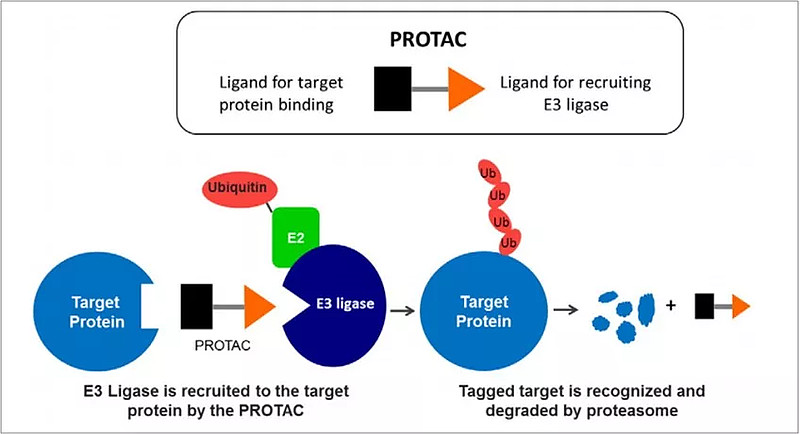
A typical PROTAC molecule consists of three components:
- A ligand that binds the target protein.
- A linker connecting both ends of the molecule.
- A ligand that recruits an E3 ubiquitin ligase.
When a PROTAC simultaneously binds the target protein and an E3 ligase, it forms a stable ternary complex.
The E3 ligase then attaches ubiquitin molecules to the target protein.
These ubiquitin tags act as cellular “disposal labels.”
Once tagged, the protein is recognized by the proteasome and degraded into amino acids.
Throughout this process, the PROTAC molecule functions primarily as a bridge or mediator. Rather than directly destroying the protein, it enables the cell to carry out the degradation itself.
This mechanism has often been described as a “borrowed knife” strategy in drug design.
What Is the Biggest Difference Between PROTACs and Traditional Inhibitors?
Although both approaches may ultimately produce therapeutic benefits, their pharmacological logic is fundamentally different.
Traditional Inhibitors: Occupancy-Driven Pharmacology
Traditional inhibitors follow what is known as Occupancy-Driven Pharmacology.
The drug must continuously occupy the target protein in order to maintain efficacy.
Once drug concentrations decline or binding is lost, protein activity can return.
PROTACs: Event-Driven Pharmacology
PROTACs operate through Event-Driven Pharmacology.
Their objective is not prolonged binding but the completion of a degradation event.
Once a target protein has been successfully degraded, the protein itself is no longer present.
Even if the PROTAC molecule dissociates, the cell must synthesize new protein before biological activity can resume.
This creates several important characteristics:
- Sustained effects may be achieved at lower doses.
- Continuous target occupancy is not required.
- Deeper target suppression may be possible.
- Certain resistance mechanisms may be reduced.
Therefore, PROTACs represent not merely a new molecular structure but a fundamentally different pharmacological paradigm.
The shift from “controlling proteins” to “eliminating proteins” is the most important distinction between the two approaches.
Why Can PROTACs Potentially Address “Undruggable” Targets?
One of the longstanding challenges in drug discovery is that not all disease-associated proteins possess suitable active sites for conventional drug binding.
Traditional small molecules typically require access to enzymatic active sites or well-defined functional domains.
However, a large proportion of the human proteome lacks such structures.
Many critical disease drivers belong to categories such as:
- Transcription factors
- Regulatory proteins
- Scaffold proteins
- Non-enzymatic proteins
Although these proteins play essential roles in disease progression, they have historically been classified as “undruggable” because of their structural characteristics.
PROTAC technology offers a different solution.
Unlike traditional inhibitors, PROTACs do not necessarily need to block a protein’s functional activity directly.
As long as a molecule can transiently recognize and bind the target protein, it may be able to recruit an E3 ligase and trigger degradation.
As a result, many previously inaccessible targets have re-entered the scope of drug development.
This expanded target space is one of the reasons PROTAC technology is viewed as a transformative platform for future therapeutics.
Can PROTACs Help Overcome Drug Resistance?
Drug resistance remains one of the most significant challenges in modern targeted therapy.
Over time, tumor cells can evade treatment through genetic mutations, pathway rewiring, or altered protein expression.
Traditional inhibitors often rely heavily on specific binding sites.
When these sites change, drug binding can weaken, leading to reduced efficacy.
PROTACs offer a potential new strategy for addressing some resistance mechanisms.
Because their ultimate goal is protein degradation rather than functional inhibition, they may retain activity in certain situations where target proteins have undergone structural changes, provided that a productive ternary complex can still form.
In addition, PROTACs eliminate both enzymatic and non-enzymatic functions of target proteins.
For proteins that possess multiple biological roles, complete removal may provide advantages over partial inhibition.
Nevertheless, PROTACs are not inherently immune to resistance.
Changes in E3 ligase expression, alterations in degradation pathways, and tumor adaptation may all contribute to resistance mechanisms unique to targeted protein degradation.
For this reason, PROTACs are generally viewed as an important new tool for addressing selected resistance pathways rather than a universal solution.
From the Era of Inhibition to the Era of Degradation
As advances in structural biology, proteomics, artificial intelligence-assisted drug design, and next-generation degradation platforms continue to accelerate, PROTAC technology may overcome many of the limitations associated with traditional drug development and provide new therapeutic opportunities for diseases that currently lack effective treatment options.
Amid this wave of innovation, global drug discovery is gradually evolving from simply identifying new targets to actively controlling the fate of disease-causing proteins.
From oncology and hematology to autoimmune diseases, neurodegenerative disorders, and rare diseases, targeted protein degradation is expanding rapidly across multiple therapeutic areas. Alongside PROTACs, emerging modalities such as molecular glues and lysosome-targeting chimeras (LYTACs) are broadening the possibilities of precision medicine and reshaping the future of drug discovery.
Conclusion
The transition from protein inhibition to protein degradation represents one of the most important conceptual shifts in modern pharmaceutical innovation.
Rather than merely blocking protein function, PROTAC technology enables the selective elimination of disease-causing proteins, expanding the range of therapeutic targets and offering potential solutions for diseases that have historically been difficult to treat.
Although many scientific and clinical challenges remain—including optimizing pharmacokinetics, improving tissue penetration, and understanding long-term resistance mechanisms—the rapid advancement of targeted protein degradation continues to generate significant interest across academia and the pharmaceutical industry.
As a professional platform dedicated to tracking advances in innovative medicines worldwide, DengYueMed closely follows developments in PROTACs, molecular glues, targeted protein degradation technologies, and other emerging therapeutic modalities. Through timely coverage of global drug approvals, clinical research updates, and biotechnology innovation trends, DengYueMed helps healthcare professionals, industry partners, and patients stay informed about the next generation of therapeutic opportunities.
From the era of inhibition to the era of degradation, PROTAC technology may be opening a new chapter in pharmaceutical innovation. As research continues to advance, targeted protein degradation is expected to become one of the defining technologies shaping the future of precision medicine.
Key Takeaways
- PROTACs eliminate disease-causing proteins rather than simply inhibiting their activity.
- Unlike traditional inhibitors, PROTACs utilize the ubiquitin-proteasome system (UPS) to trigger protein degradation.
- PROTACs follow an event-driven pharmacology model instead of occupancy-driven pharmacology.
- Targeted protein degradation may enable treatment of previously “undruggable” proteins.
- PROTAC technology has the potential to overcome certain forms of drug resistance.
- Together with molecular glues and other degradation platforms, PROTACs are reshaping the future of precision medicine and drug discovery.