Donafenib Tosylate Tablets
China’s Innovative Targeted Therapy for Liver and Thyroid Cancer
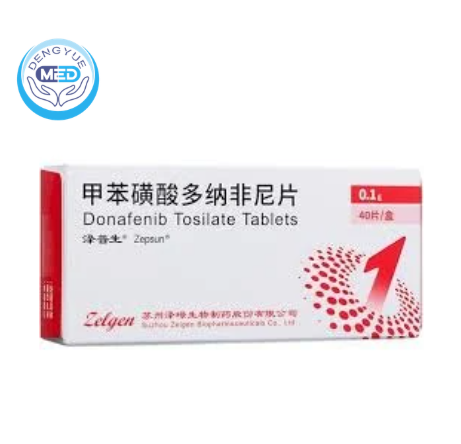
In the evolution of modern oncology, targeted therapies represent a major turning point.
Within our broader Oncology Insights series, Donafenib Tosylate stands out as a Class 1 innovative drug developed in China with independent intellectual property rights.
Approved for hepatocellular carcinoma and radioactive iodine-refractory differentiated thyroid cancer, donafenib reflects China’s growing innovation capability in oncology drug development.
What Is Donafenib?
Donafenib tosylate is an oral, small-molecule, multi-target multi-kinase inhibitor.
It was structurally optimized from sorafenib through deuterium substitution — a modification that enhances molecular stability and slows metabolic degradation. This pharmacokinetic optimization aims to improve tolerability while maintaining or enhancing anti-tumor efficacy.
Mechanistically, donafenib functions as a signal pathway inhibitor, blocking tumor proliferation and angiogenesis through multiple kinase targets.
Approved Indications
1. Unresectable Hepatocellular Carcinoma (HCC)
Donafenib was first approved in China for patients with unresectable hepatocellular carcinoma who have not previously received systemic therapy.
HCC remains a major health burden in China, with a high proportion of cases associated with chronic hepatitis B virus infection.
In the pivotal ZGDH3 clinical trial, donafenib was compared head-to-head with sorafenib, previously the standard first-line therapy.
Key findings included:
- Significant improvement in overall survival
- Lower incidence of certain adverse events
- Improved tolerability profile
This marked the first substantial advancement over sorafenib in nearly a decade within this treatment setting.
2. Radioactive Iodine-Refractory Differentiated Thyroid Cancer (RAIR-DTC)
Donafenib is also approved for:
- Locally advanced or metastatic
- Radioactive iodine-refractory
- Differentiated thyroid cancer
For broader analysis on rare and complex treatment landscapes, see our Rare Disease Insights section.
Mechanism of Action: Dual Anti-Tumor Strategy
Donafenib exerts anti-tumor effects through two principal mechanisms:
Inhibition of Tumor Cell Proliferation
It inhibits Raf kinase and blocks the Raf/MEK/ERK signaling pathway.
Suppression of Tumor Angiogenesis
It inhibits receptor tyrosine kinases including:
- VEGFR
- PDGFR
By disrupting angiogenesis, it limits tumor blood supply and tumor expansion.
Supply and Compliance Considerations
For innovative oncology drugs entering cross-border markets, regulatory compliance and temperature-controlled logistics are equally critical.
You may also read our analysis on
Global Pharmaceutical Supply Chain Risk
to understand how delivery reliability increasingly shapes procurement decisions.
Future Directions
Ongoing research is exploring donafenib in:
- Combination regimens
- Postoperative adjuvant settings
- Conversion therapy for unresectable liver tumors
As discussed across our broader DengYueMed platform, innovation is no longer limited to molecule development — it increasingly includes regulatory readiness and supply chain robustness.
DengYue Perspective
Donafenib illustrates the growing role of Chinese-developed innovative drugs in global oncology.
Beyond pricing considerations, its significance lies in:
- Demonstrated clinical survival benefit
- Improved tolerability profile
- Independent intellectual property
- Expanding global research participation
As oncology treatment evolves toward precision and combination strategies, domestically developed targeted therapies are increasingly contributing to international therapeutic standards.
DengYue Medical
Global Oncology Intelligence | Cross-Border Pharmaceutical Access | Regulatory & Supply Chain Insight