NaPi2b Emerges as a New Ovarian Cancer Target: Two ADC Therapies Report Encouraging Clinical Data
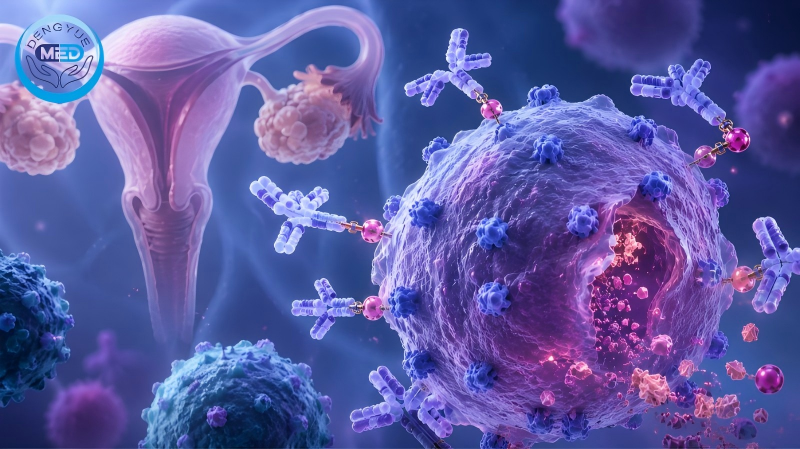
At the 2026 ASCO Annual Meeting, new developments once again drew attention in the ovarian cancer ADC field.
HongKong DengYueMed reviewed the latest advances in ovarian cancer therapies presented at this year’s conference. Among them, early clinical data from two NaPi2b-targeting antibody-drug conjugates (ADCs), YL205 and TUB-040, attracted significant industry interest.
The data showed that in heavily pretreated ovarian cancer patients, including many with platinum-resistant disease, both therapies demonstrated objective response rates (ORR) approaching or exceeding 50%, while disease control rates (DCR) surpassed 95%.
Notably, TUB-040 achieved a confirmed ORR of 60.9%, with some patients even reaching complete response (CR).
For ovarian cancer, a field that has long lacked breakthrough late-line treatment options, NaPi2b is rapidly emerging as a new focal point in ADC development.
Why Is NaPi2b Becoming a New Focus in Ovarian Cancer ADC Development?
NaPi2b is a sodium-dependent phosphate transport protein that is highly expressed in ovarian cancer, particularly in high-grade serous ovarian carcinoma.
More importantly, this protein has strong internalization capability, allowing ADC therapies to rapidly enter tumor cells after antibody binding, making it an ideal ADC target.
Compared with traditional chemotherapy, ADCs are designed for precision delivery. The antibody identifies tumor cells, while the cytotoxic payload selectively kills them. For this reason, ADCs are often described as a form of “targeted chemotherapy.”
The growing interest in NaPi2b is mainly driven by several factors:
- High expression rates in ovarian cancer
- Favorable internalization properties for ADC delivery
- Potentially broader patient coverage
- Opportunity to become the next major ADC target after FRα
Particularly noteworthy is the observation from the YL205 study that efficacy did not appear to strongly correlate with NaPi2b expression levels.
This suggests that not only high-expression patients, but also those with medium or low expression, may potentially benefit from treatment.
YL205: Clinical Activity Independent of High Target Expression
YL205, developed by Suzhou Medilink Therapeutics, is a NaPi2b-targeting ADC therapy.
The drug utilizes the TMALIN technology platform, conjugating an anti-NaPi2b antibody with a topoisomerase I (TOP1) inhibitor payload. It can be viewed as a “precise targeting plus localized chemotherapy” strategy.
The presented YL205-CN-101-01 trial is a multicenter Phase I/II clinical study enrolling patients with advanced solid tumors, primarily ovarian cancer.
Most enrolled patients had already failed multiple standard therapies and represented a heavily pretreated population.
Patient Characteristics
As of December 2025, the study included 48 ovarian cancer patients:
- More than one-third had received ≥4 prior lines of therapy
- Most patients had previously received bevacizumab
- Nearly half had received PARP inhibitors
- Some patients had previously received ADC therapies
This indicates that YL205 was evaluated in patients with very limited remaining treatment options.
Efficacy Data
Among 43 evaluable patients:
- Confirmed ORR reached 46.5%
- DCR reached 95.3%
- Most responses remained ongoing
In other words, nearly half of the patients experienced significant tumor shrinkage, while disease stabilization was achieved in the vast majority of patients.
Even more importantly, clinical responses were observed regardless of NaPi2b expression levels.
This finding is highly meaningful in the ADC field.
Many ADC therapies require high target expression levels to achieve strong efficacy. However, YL205 data suggest that strict high-expression patient selection may not be necessary, potentially broadening the eligible patient population.
Safety Profile
YL205 demonstrated generally manageable tolerability. The main adverse events included:
- Neutropenia
- Anemia
- Nausea and vomiting
- Decreased appetite
Most adverse events were mild to moderate in severity, and the maximum tolerated dose was not reached, indicating further room for dose optimization.
TUB-040: More Than 60% Response Rate in Platinum-Resistant Patients
Another highly anticipated NaPi2b ADC is TUB-040, developed by German biotechnology company Tubulis GmbH.
Although it targets the same antigen, TUB-040 follows a different technological approach:
- Exatecan payload
- Drug-antibody ratio (DAR) of 8
- Stable cleavable linker
- Strong bystander effect
The so-called bystander effect means that even tumor cells with low target expression may still be affected through drug diffusion into surrounding cells, thereby expanding tumor-killing activity.
Patient Population Characteristics
The NAPISTAR 1-01 trial enrolled typical platinum-resistant ovarian cancer patients:
- Median prior treatment lines reached 4
- Some patients had received up to 7 prior therapies
- 76% had previously received PARP inhibitors
- 84% had previously received bevacizumab
Overall, this represents a more complex and real-world late-line treatment population than many early-stage studies.
Efficacy Results
Among 46 evaluable patients:
- Confirmed ORR reached 60.9%
- DCR reached 96%
- Two patients achieved complete response (CR)
- 90% of responses remained ongoing
Particularly notable findings included:
- ORR still reached 71% in patients receiving ≥4 prior treatment lines
- Responses remained consistent regardless of prior PARP inhibitor or bevacizumab exposure
These findings suggest that TUB-040 not only demonstrates a high response rate, but also maintains strong activity in heavily pretreated patients.
Safety Profile
The main adverse events associated with TUB-040 included:
- Nausea
- Fatigue
- Neutropenia
- Anemia
- Diarrhea and vomiting
No treatment-related deaths were reported, and no patients discontinued treatment due to toxicity.
Although a small number of Grade 1 interstitial lung disease cases occurred, all recovered successfully, indicating an overall manageable safety profile.
What Do These Two NaPi2b ADCs Mean for the Industry?
Although both therapies remain in early-stage clinical development, these studies already highlight several important industry trends.
1. Competition in Ovarian Cancer ADCs Is Intensifying
Previously, ovarian cancer ADC development was largely centered around FRα.
Now, NaPi2b is emerging as a new competitive target. In the future, ovarian cancer ADC development may enter a multi-target era.
2. Late-Line Ovarian Cancer Treatment May Be Approaching a Breakthrough
For patients who have already failed multiple therapies:
- ORRs of 46%–60%
- DCRs exceeding 95%
These are already highly competitive clinical outcomes.
This suggests that ADC therapies may begin redefining the treatment landscape for late-line ovarian cancer.
3. ADC Technology Strategies Are Evolving
YL205 emphasizes:
- Reduced dependence on high target expression
- Broader potential patient coverage
Meanwhile, TUB-040 focuses more on:
- High DAR design
- Strong bystander effect
- Enhanced tumor-killing capability
Future ADC competition may therefore shift away from simply identifying stronger targets, toward achieving sustained efficacy in complex tumor environments.
Conclusion
Based on the currently available data, NaPi2b is rapidly becoming one of the most promising new targets in ovarian cancer ADC development.
YL205 demonstrated broad coverage potential and activity independent of high target expression, while TUB-040 delivered an impressive confirmed ORR exceeding 60% in platinum-resistant patients.
As global ADC development continues to accelerate, innovation in oncology increasingly depends not only on drug discovery and clinical development, but also on stable global pharmaceutical supply chains and international drug distribution systems.
Global pharmaceutical distributor DengYueMed will continue tracking developments in ADCs, oncology therapies, and emerging international treatment innovations, while also focusing on global accessibility and supply infrastructure for advanced therapies.
Related Posts
- New Progress in First-Line Treatment of HER2-Positive Breast Cancer: Trastuzumab Deruxtecan Plus Pertuzumab Approved
- A New Breakthrough in Colorectal Cancer ADC Therapy: Trastuzumab Rezetecan Approved for HER2-Positive Colorectal Cancer in China
- Gastric Cancer Treatment Is No Longer Just About Chemotherapy: How Precision Medicine Is Shaping the Future | A Comprehensive Guide to HER2, CLDN18.2, and FGFR2b