A Breakthrough in Nebulized Antiviral Therapy: Phase III Progress of Peramivir Inhalation Solution

In the field of influenza treatment, traditional therapies have long relied on oral and intravenous administration routes. While these approaches are clinically effective in inhibiting viral replication, they still present limitations in onset speed, tissue distribution, and patient adherence.
In respiratory infectious diseases in particular, drugs must pass through systemic circulation before reaching the site of action, which may delay therapeutic onset and reduce local drug concentration at the infection site.
With the continuous advancement of drug delivery technologies, antiviral treatment is gradually shifting from systemic therapy toward localized targeted delivery. In this context, nebulized inhalation formulations are emerging as an important innovation in respiratory disease treatment, demonstrating unique clinical value and industrial significance.
Against this backdrop, the development progress of peramivir inhalation solution has attracted widespread attention across the industry.
Smooth Phase III Progress, Entering the Key Data Analysis Stage
The product has successfully completed patient enrollment and completion in its Phase III clinical trial and has now entered the stage of statistical analysis and data summarization.
According to publicly available information and typical study designs, Phase III trials are generally multicenter, randomized, double-blind, and placebo-controlled, aiming to systematically evaluate the efficacy and safety of the treatment in adults with uncomplicated influenza.
The completion of enrollment in Phase III indicates that the product has transitioned from early exploratory research into the final stage of confirmatory clinical evaluation. The upcoming results will serve as critical evidence for regulatory submission and clinical assessment, marking a key milestone in its development program.
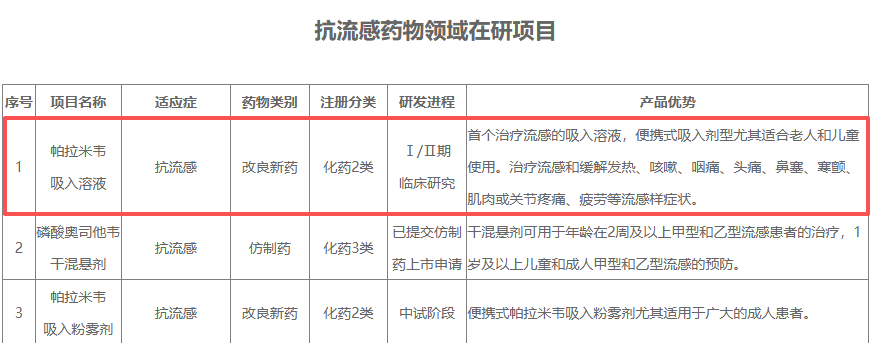
Formulation Innovation: Nebulized Delivery for Respiratory Tract Targeting
The core value of peramivir inhalation solution lies not only in the drug itself but also in its systematic innovation in drug delivery.
The product adopts a nebulized inhalation route, enabling direct delivery of the drug into the respiratory tract, thereby creating a clear differentiation from traditional oral or intravenous administration.
1️⃣ Localized High-Efficiency Delivery
Influenza viruses primarily replicate in the upper respiratory tract and pulmonary epithelial cells. Nebulized inhalation allows the drug to deposit directly at the site of infection, increasing local drug concentration and enhancing target engagement.
2️⃣ Shorter Onset Pathway
Compared with oral formulations that require gastrointestinal absorption and hepatic first-pass metabolism, inhaled formulations bypass parts of systemic metabolic processes, enabling faster delivery to the site of action and potentially improving early intervention efficiency.
3️⃣ Reduced Systemic Exposure
Localized delivery may reduce the proportion of drug entering systemic circulation, thereby potentially lowering systemic exposure and providing a theoretical safety advantage.
Clinical Evidence: Preliminary Efficacy and Safety Signals Established
In previous Phase II clinical studies, the inhalation formulation demonstrated encouraging trends.
Findings suggested that in adult patients with uncomplicated influenza, the treatment may:
- Shorten viral clearance time
- Reduce duration of influenza symptoms
- Show generally favorable safety, with most adverse events being mild
- No grade 3 or higher serious adverse events observed
These findings provide important support for the Phase III confirmatory study and offer early clinical evidence for the feasibility of inhaled antiviral therapy.
A Paradigm Shift in Influenza Treatment Strategy
For decades, antiviral influenza therapies have primarily focused on neuraminidase inhibitors and similar mechanisms, with oral and intravenous administration as the dominant clinical forms.
Although well established, this approach still has limitations, including dependence on absorption pathways, relatively high systemic exposure, and restricted early intervention windows.
The emergence of peramivir inhalation solution represents a shift from drug-centered optimization to delivery-system innovation.
This transformation is reflected in three dimensions:
- From systemic therapy to localized respiratory tract targeting
- From dependence on absorption to direct action at the disease site
- From single-formulation competition to delivery-platform competition
In respiratory infectious diseases, this type of pathway innovation has strong potential for further development and may contribute to the evolution of future antiviral treatment paradigms.
Industry and Clinical Significance: A Key Direction for Respiratory Formulation Innovation
From a global R&D perspective, inhalation formulations are becoming an important innovation platform for respiratory diseases, including inhaled anti-infectives, antiviral inhalation therapies, and mucosal immunity-related products.
The development progress of peramivir inhalation solution sits at the intersection of this trend.
Its significance lies not only in expanding treatment options for influenza but also in advancing therapeutic models by:
- Enhancing precision drug delivery in respiratory diseases
- Improving drug distribution at target tissues
- Increasing patient convenience and adherence
- Expanding the boundaries of antiviral formulation innovation
In this process, DengYueMed continues to closely follow global innovations in respiratory therapeutics, with a focus on drug delivery systems and clinical translation pathways, supporting the systematic interpretation and dissemination of industry developments.
Conclusion
As the Phase III study enters the data analysis stage, upcoming results will further clarify the clinical value and application potential of peramivir inhalation solution.
From an industry perspective, this program represents more than the development of a single antiviral agent. It reflects the transition of influenza therapy into a new era characterized by nebulized inhalation and respiratory tract-targeted delivery.
This shift may reshape antiviral treatment strategies and provide new directions for formulation innovation in respiratory diseases.
Related Posts
- Mirdametinib vs Selumetinib: Which MEK Inhibitor Is Better for Neurofibromatosis Type 1 (NF1)?
- From Frequent Management to Long-Acting Treatment: How Plozasiran's Three-Month Dosing Is Changing FCS Care
- China's First Generic Tiotropium Bromide and Olodaterol Inhalation Spray Approved: Ending an 8-Year Market Exclusivity and Bringing New Options for COPD Treatment