Oral Dissolving Films: A New Dosage Form Transforming the Modern Medication Experience
For most people, taking medicine seems like a very ordinary part of life. However, not everyone can easily swallow pills.
Many children cry or resist when they see tablets; some elderly people experience choking or discomfort because of reduced swallowing ability; and patients who are bedridden, living with Parkinson’s disease, or suffering from certain mental health conditions may also struggle to take traditional solid oral medications.
For a long time, “how to make medication easier to take” has been an important focus of the pharmaceutical industry. With the continuous advancement of drug delivery technologies, a more patient-friendly and convenient dosage form — Oral Dissolving Films (ODFs) — is gradually attracting global attention.
As a platform that continuously follows global innovative medicines and pharmaceutical dosage form developments, DengYueMed is also paying close attention to emerging drug delivery technologies, including oral dissolving films. Compared with traditional tablets and capsules, ODFs are not only changing the way people take medicine, but also improving the medication experience for many patients.
What Are Oral Dissolving Films?
According to the 2025 edition of the Pharmacopoeia of the People’s Republic of China, film preparations are defined as film-shaped dosage forms made from active pharmaceutical ingredients and suitable film-forming materials for oral or mucosal use. Among them, oral dissolving films refer to films that rapidly dissolve in the mouth and exert either local or systemic effects.
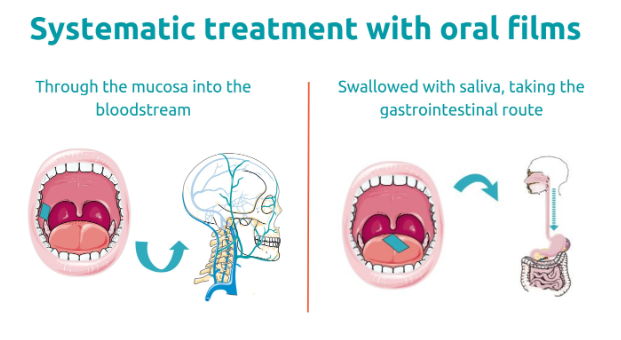
Simply put, oral dissolving films are thin, flexible, stamp-sized medicated films. Patients only need to place the film on the tongue or inside the mouth. Without water or chewing, the film quickly disintegrates in saliva and releases the medication.
The released drug may then:
- Be directly absorbed through the oral mucosa;
- Or enter the gastrointestinal tract together with saliva for further absorption.
Compared with traditional tablets, capsules, and some orally disintegrating tablets, ODFs are lighter, easier to use, and less likely to cause choking, which is why they have gained increasing attention in recent years.
Why Are Oral Dissolving Films Becoming More Popular?
1. Making Medication Easier to Take
Traditional tablets often require complete swallowing, which can be difficult for many patients.
This is especially true for:
- Children;
- Elderly individuals;
- Patients with swallowing difficulties;
- Bedridden patients;
- Patients with mental health disorders.
For these groups, simply “taking medicine on time” can become a challenge.
ODFs dissolve rapidly in the mouth, significantly reducing the difficulty of medication administration.
Many children resist medication not necessarily because of the medicine itself, but because they are afraid of swallowing pills or dislike bitter tastes. ODFs are small, dissolve quickly, and can incorporate taste-masking technologies, making them easier for children to accept.
For elderly patients, ODFs also reduce the risk of choking during medication intake.
2. Faster Drug Absorption
The oral mucosa contains a rich network of capillaries.
After the drug is released in the mouth, part of it may directly enter the bloodstream through the mucosal membrane, which can:
- Reduce degradation by gastric acid;
- Avoid part of the liver’s first-pass metabolism;
- Improve drug absorption efficiency;
- Shorten the onset time of the medication.
As a result, ODFs are particularly suitable for medications that require rapid action.
3. Better Suited for Modern Lifestyles
ODFs are usually compact, lightweight, and do not require water for administration, making them highly portable.
For people who need long-term medication, they provide greater convenience during:
- Business trips;
- Travel;
- Outdoor activities.
A Tiny Film Backed by Advanced Pharmaceutical Technology
Although oral dissolving films appear simple, their production involves sophisticated pharmaceutical technologies.
A qualified ODF typically contains several important components:
- Active pharmaceutical ingredients (APIs), which provide the therapeutic effect;
- Film-forming materials, which create the thin-film structure;
- Plasticizers, which improve flexibility and prevent brittleness;
- Flavoring and taste-masking agents, which improve patient acceptance;
- Stabilizers, which help maintain product quality and shelf life.
For example, sweeteners such as mannitol or sucrose may be added to improve taste, while surfactants such as poloxamers can accelerate film dissolution.
These supporting ingredients play a critical role in determining:
- Dissolution speed;
- Flexibility;
- Stability;
- Drug release performance;
- Overall patient experience.
Which Drugs Are Already Using ODF Technology?
In recent years, multiple ODF products have been launched globally.
Current applications commonly include:
- Anti-allergy medications;
- Antiemetics;
- Pain relief medications;
- Neurological disorder treatments;
- Pediatric medicines.
Examples include:
- Montelukast Sodium Oral Dissolving Films;
- Ondansetron Oral Dissolving Films.
In addition, drugs for cardiovascular diseases, neurological disorders, and chronic disease management are also being explored in ODF formulations.
With the continuous advancement of innovative drugs and drug delivery systems, more medications may adopt ODF technology in the future.
Why ODF Technology Matters for the Pharmaceutical Industry
The rise of oral dissolving films reflects a broader transformation in modern pharmaceutical development.
In the past, drug development mainly focused on discovering effective active ingredients. Today, pharmaceutical companies are increasingly emphasizing:
- Patient-centered medication design;
- Improved treatment adherence;
- Better user experience;
- More flexible delivery systems;
- Precision drug release technologies.
As healthcare systems continue evolving globally, patient convenience is becoming an increasingly important factor in treatment success.
For pharmaceutical manufacturers and global distributors, innovative dosage forms like ODFs also create new opportunities in:
- Pediatric medicine development;
- Chronic disease management;
- Portable medication solutions;
- Personalized healthcare products.
Conclusion
As medical technology advances, the pharmaceutical industry is paying increasing attention to “patient experience.” Medicines are no longer expected to be only effective — they should also be convenient and comfortable for patients to use.
Oral dissolving films are a strong example of this trend. They are not only changing the way medicines are taken, but also improving the overall treatment experience for many patients.
In modern healthcare, an ideal medication should not only “work effectively,” but also be “easy for patients to accept.” Oral dissolving films are helping make medication intake simpler, more comfortable, and more human-centered.