When APIs Are Controlled by a Few Companies: How Risks Spread Across the Pharmaceutical Supply Chain
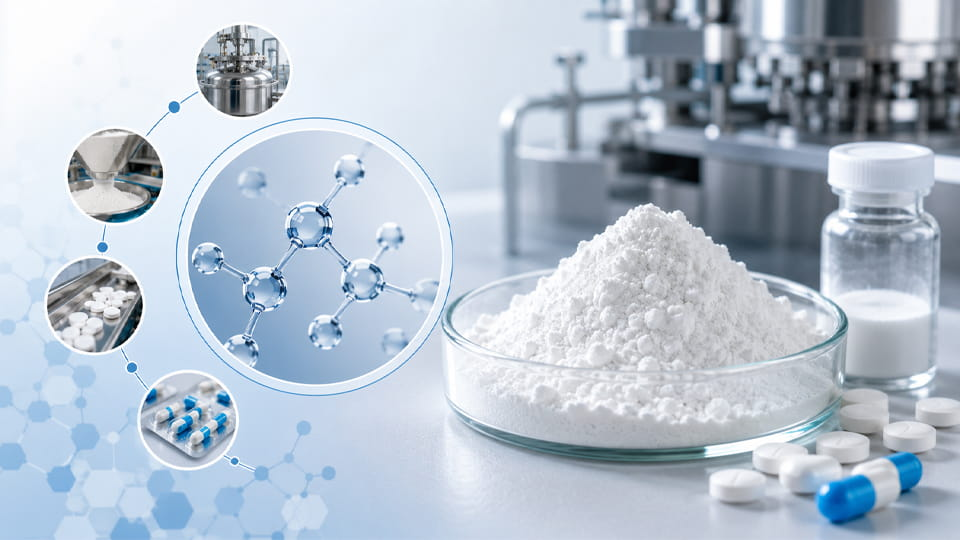
In the global pharmaceutical industry, active pharmaceutical ingredients (APIs) are often one of the most overlooked parts of the supply chain.
Patients pay more attention to drug brands, hospitals focus on product availability, and capital markets focus on innovative drugs. However, what truly determines whether a medicine can be consistently manufactured and supplied is often the upstream API sector.
As a distributor involved in global pharmaceutical and API supply chains, DengYueMed has also been closely following how changes in the global API supply landscape are affecting downstream drug markets.
Over the past decade, global API production has become increasingly concentrated in a small number of countries and large manufacturers.
Once a key supplier faces shutdowns, production cuts, environmental inspections, or export restrictions, the impact does not remain upstream. Instead, it spreads throughout the entire pharmaceutical supply chain.
From finished drug manufacturers to hospital procurement systems and eventually patients, the risks become amplified layer by layer.
How Do Risks Spread from Upstream to Downstream?
Many people assume that problems at API manufacturers only affect upstream markets.
In reality, APIs have a strong “leverage effect” within the pharmaceutical supply chain.
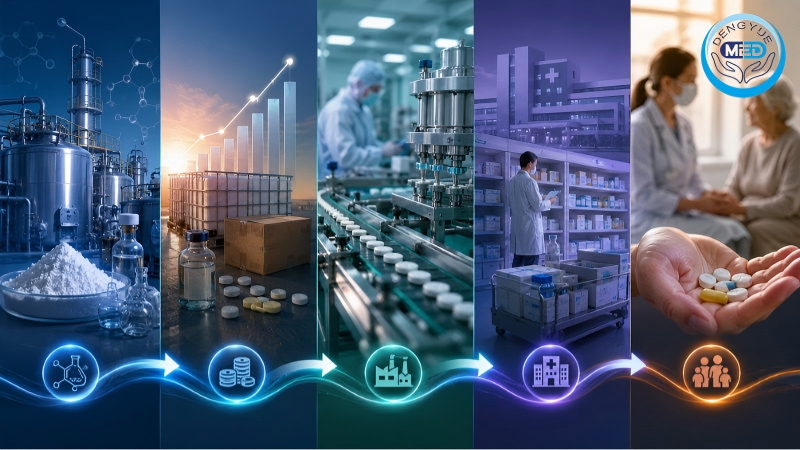
An issue that begins at an upstream manufacturing facility can eventually lead to reduced drug production, hospital shortages, treatment interruptions for patients, and even disruptions to broader pricing systems.
This transmission of risk usually does not happen instantly. It expands step by step across the supply chain.
Layer 1: API Supply Disruptions Begin to Destabilize the Market
Risks often start with seemingly ordinary events, such as:
- Environmental shutdowns at key API plants
- Export policy changes
- Supply interruptions of critical intermediates
- Failed quality inspections or audits
- Rising energy costs leading to reduced production
- Geopolitical or logistics disruptions
If there are enough suppliers in the market, these issues may have limited impact.
However, many API markets today are already highly concentrated. For some commonly used medicines, only two or three manufacturers may still have large-scale production capacity, while some low-cost essential drugs rely heavily on a single source.
Once one supplier stops production, market balance can quickly collapse.
The first signs usually include:
- Rapid increases in spot prices
- Longer delivery lead times
- Increased stockpiling in the market
- Greater procurement pressure on drug manufacturers
And this is often only the beginning of the disruption.
Layer 2: Rising API Costs Pressure Finished Drug Manufacturers
For pharmaceutical manufacturers, APIs are not just another procurement item — they are the core resource that determines whether production can continue.
This is especially true in the generic drug and low-cost medicine sectors, where APIs often account for a large share of production costs.
Once API prices rise, downstream manufacturers immediately face pressure.
The problem is that many pharmaceutical companies cannot quickly increase the prices of finished drugs.
Hospital procurement systems, reimbursement frameworks, centralized purchasing programs, and long-term supply agreements often limit pricing flexibility.
As a result:
API costs continue rising, while finished drug prices remain relatively fixed, rapidly squeezing profit margins.
For low-margin essential medicines, some companies may eventually reach a point where continued production becomes financially unsustainable, forcing them to reduce output or exit the market entirely.
Layer 3: Drug Manufacturers Cannot Quickly Switch Suppliers
Many people ask: why not simply change API suppliers?
In reality, switching suppliers is far more difficult than it appears.
Pharmaceutical manufacturing is heavily dependent on regulatory compliance. The API source for an approved drug has usually already gone through registration filings, process validation, stability testing, and quality consistency evaluations.
Changing suppliers often requires:
- New quality validation procedures
- Updated regulatory documentation
- Additional stability studies
- In some countries, new regulatory approvals
In highly regulated markets such as the United States and Europe, this process can take months or even longer.
This means that even if alternative API suppliers exist, pharmaceutical companies may not be able to switch immediately.
As a result, many manufacturers can only rely on existing inventory during the early stages of disruption.
Once inventories are depleted, production cuts and temporary shutdowns begin to emerge.
Layer 4: Reduced Drug Supply Starts Affecting Hospitals
As more manufacturers reduce output, the problem begins reaching healthcare systems.
Hospitals typically do not maintain large long-term inventories, especially for low-cost essential medicines that are often purchased through periodic replenishment systems.
When supply disruptions continue for several months, hospitals quickly begin to experience pressure.
Common signs include:
- Longer delivery times
- Frequent shortages of certain medicines
- Procurement restrictions
- Physicians being forced to adjust treatment plans
This impact becomes especially serious in oncology, chronic disease management, and anti-infective treatment areas.
Many medicines simply do not have fully equivalent alternatives.
Layer 5: Risks Ultimately Reach Patients
Supply chain risks eventually reach patients.
For patients, the most direct consequences include:
1. Treatment Interruptions
Patients who rely on long-term medication may experience serious treatment disruptions once shortages occur.
2. Forced Switching to Alternative Therapies
Some patients may need to adapt to new side effects or revised treatment regimens.
3. Rising Treatment Costs
During supply shortages, prices for certain medicines may rise significantly.
4. Widening Global Supply Inequality
Markets with stronger purchasing power are often prioritized during shortages, while lower-income countries are more vulnerable to supply disruptions.
This is why more countries are now discussing pharmaceutical supply chain security.
Because API-related issues are no longer just industrial challenges — they are increasingly becoming public health concerns.
Why Are These Risks Becoming More Common?
For many years, the global pharmaceutical industry prioritized efficiency above all else.
To reduce costs, companies continuously minimized supply chain redundancy through:
- Lower inventory levels
- More centralized procurement
- Greater reliance on single low-cost suppliers
- Larger-scale production concentration
This model works efficiently during stable periods.
However, the more concentrated the supply chain becomes, the weaker its resilience becomes.
Today, problems at a single API manufacturing facility can potentially affect drug supplies across multiple countries.
This is also why the global pharmaceutical industry is increasingly focusing on supply chain resilience.
Global Pharmaceutical Supply Chains Are Being Restructured
For decades, efficiency remained the primary priority in global pharmaceutical supply chains.
But in recent years, public health crises, geopolitical tensions, and logistics disruptions have pushed many countries to recognize that overreliance on a single API source is itself a major supply chain risk.
As a result, several global trends are emerging:
- Pharmaceutical companies are building dual- or multi-supplier systems
- Western countries are encouraging localized production of key APIs
- Governments are increasing reserves of essential medicines
- China’s importance in the global API industry continues to grow
In the near term, China remains one of the world’s most important API production hubs.
From fermentation-based APIs to specialty chemical ingredients and certain high-barrier oncology APIs, China continues to maintain strong advantages in manufacturing scale, process maturity, and supply efficiency.
Conclusion
APIs may seem far removed from patients, but they ultimately determine the stability of the pharmaceutical supply chain.
In the future, competition in the pharmaceutical industry may not only be about who develops more innovative drugs, but also about who can build a more stable, secure, and resilient supply system.
And APIs remain one of the most critical — yet most overlooked — parts of that system.
As a global pharmaceutical and API distributor, HongKong DengYueMed will continue monitoring global API supply trends, pharmaceutical market dynamics, and international drug distribution developments, while providing industry insights into China’s API sector, innovative medicines, and evolving global supply chains.
Related Posts
- Why Do Primary Healthcare Facilities Frequently Experience Drug Supply Shortages? Strengthening the Pharmaceutical Supply Chain for Continuous Access to Medicines
- How Pharmaceutical Distributors Respond to Transportation Requirements for Different Dosage Forms
- Geopolitics and Pricing Systems Reshaping Global Pharmaceutical Competition