Mapping China's RAS Pipeline Landscape: From “Undruggable” Target to a New Frontier in Oncology Innovation
In recent years, RAS has emerged as one of the most closely watched targets in global oncology drug development. From the historic breakthrough of KRAS G12C inhibitors to the rapid advancement of KRAS G12D, Pan-KRAS therapies, and RAS pathway combination strategies, innovative approaches are continuously reshaping the future of precision oncology.
At the same time, sustained investments from global pharmaceutical companies, biotech firms, and venture capital have transformed the RAS field into one of the most competitive areas in cancer drug research.
Against this backdrop, China’s biopharmaceutical industry has attracted growing attention. For many years, key RAS-related technologies and development programs were concentrated in the United States and Europe. However, an increasing number of Chinese pharmaceutical companies have entered the field, building comprehensive RAS-focused pipelines while actively participating in global clinical development and international collaborations.
As the industry evolves from technology adoption to independent innovation, Chinese companies are becoming an increasingly important force in advancing RAS-targeted therapies worldwide.
What Is the RAS Target?
RAS refers to a family of proteins that play a central role in regulating cell growth, differentiation, and intracellular signaling. The family primarily consists of three isoforms:
- KRAS
- NRAS
- HRAS
Under normal physiological conditions, RAS proteins function as molecular switches that help cells respond appropriately to external growth signals.
When mutations occur in RAS genes, however, the resulting proteins can become permanently activated, continuously transmitting growth signals that drive uncontrolled cell proliferation and tumor progression.
As a result, RAS mutations are recognized as major oncogenic drivers across a wide range of solid tumors.
Among all RAS mutations, KRAS is by far the most prevalent. It is frequently found in:
- Non-small cell lung cancer (NSCLC)
- Colorectal cancer
- Pancreatic cancer
In pancreatic cancer in particular, KRAS mutations are present in more than 90% of patients, making the pathway one of the most attractive targets in oncology research and drug development.
From “Undruggable” to Breakthrough Innovation
Although the clinical importance of RAS has been recognized for decades, developing effective therapies against it proved exceptionally challenging.
The surface of the RAS protein lacks deep binding pockets that traditional small-molecule drugs typically require, leading many researchers to label it an “undruggable” target.
Advances in structural biology, computational drug design, and protein engineering eventually changed this perception.
Researchers discovered that certain KRAS mutations create unique structural features that can be exploited therapeutically. Among them, KRAS G12C became the first mutation successfully targeted by small-molecule inhibitors.
The approval of KRAS G12C-targeted therapies marked a turning point in oncology drug development. More importantly, it validated the druggability of the RAS pathway and reignited global interest in a target that had long been considered beyond reach.
RAS Signaling Pathway and Therapeutic Intervention
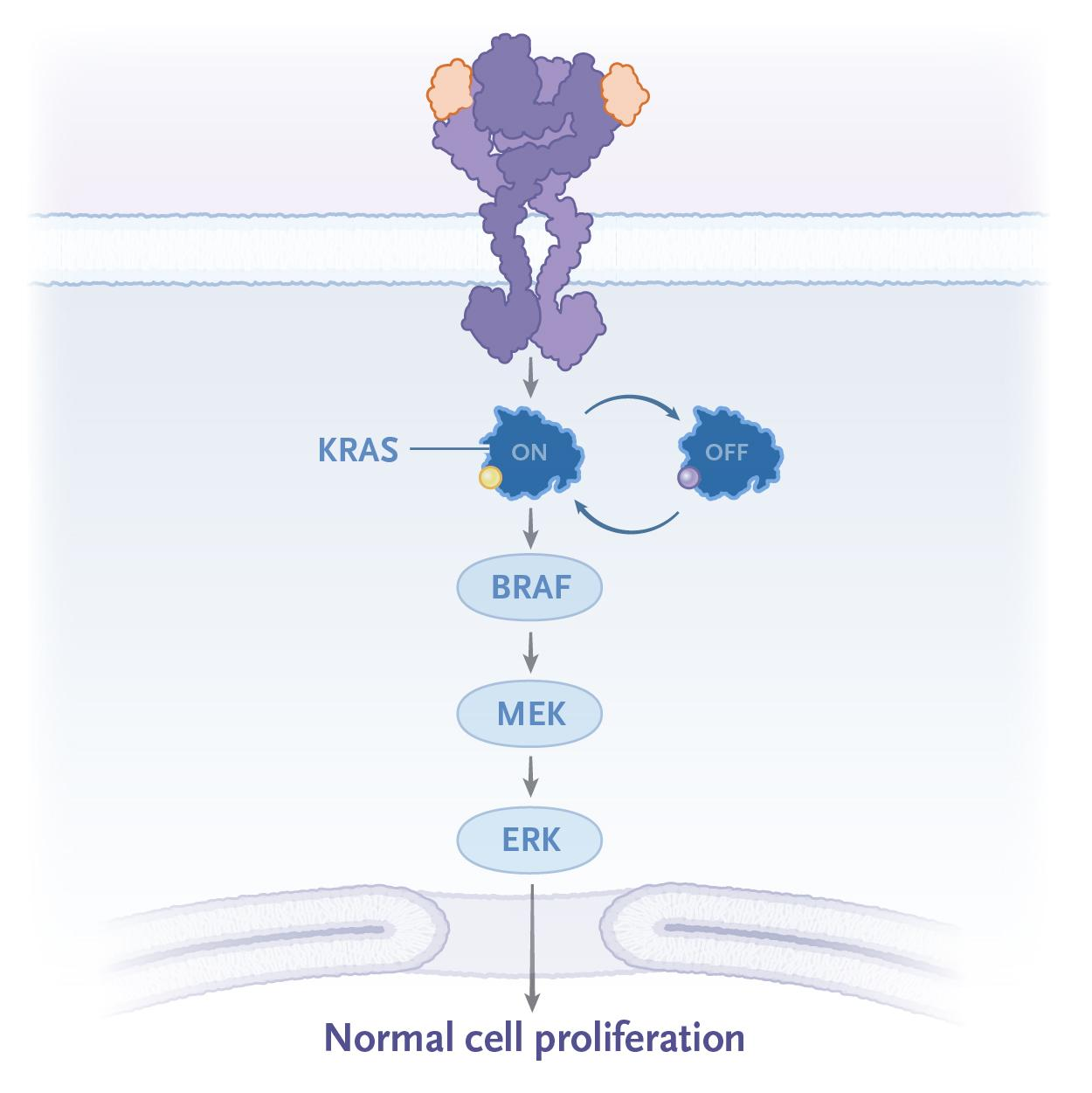
The RAS-MAPK pathway is one of the most important signaling cascades controlling cellular growth and proliferation.
When KRAS becomes mutated and remains in an activated state, downstream proteins such as:
- BRAF
- MEK
- ERK
continue transmitting growth signals, ultimately promoting uncontrolled tumor development.
This pathway has become the foundation for multiple targeted therapy strategies currently under development worldwide.
Why Has KRAS G12C Become a Key Milestone for Chinese Biopharma?
As the first commercially successful RAS-targeted approach, KRAS G12C has played a pivotal role in accelerating innovation across the entire field.
Because this mutation provides a relatively well-defined binding mechanism, it became the initial focus of pharmaceutical companies seeking to unlock the therapeutic potential of RAS.
Chinese companies have made remarkable progress in this area. Several domestically developed KRAS G12C inhibitors have advanced into late-stage clinical development and commercialization, demonstrating China’s growing capabilities in cutting-edge oncology innovation.
These achievements not only reflect significant scientific progress but also highlight the increasing competitiveness of China’s biopharmaceutical sector on the global stage.
As the market matures, however, competition is shifting beyond first-in-class development toward areas such as:
- Efficacy optimization
- Combination treatment strategies
- Expansion into additional tumor indications
Consequently, KRAS G12C has become more than just a successful product category—it has established a foundation for the next generation of RAS-targeted therapies.
Why Is KRAS G12D Considered the Next Major Opportunity?
As KRAS G12C moves into a more mature stage of development, attention is increasingly turning toward KRAS G12D, another highly significant mutation subtype.
Compared with G12C, KRAS G12D occurs more frequently in pancreatic and colorectal cancers, giving it a substantially larger potential patient population and commercial opportunity.
At the same time, drug development against KRAS G12D presents greater technical challenges.
Unlike G12C, the mutation lacks a naturally accessible binding pocket, requiring entirely new approaches to molecular design and target engagement.
This complexity has made KRAS G12D one of the most scientifically challenging areas in oncology today.
Despite these obstacles, numerous pharmaceutical companies around the world are actively pursuing KRAS G12D programs, including a growing number of Chinese innovators.
As clinical development progresses, many industry observers believe that KRAS G12D could become the next major value driver in the RAS landscape.
Pan-KRAS Is Emerging as a New Development Hotspot
As researchers gain a deeper understanding of tumor heterogeneity, it has become increasingly clear that therapies targeting a single mutation may not be sufficient to address the diverse needs of cancer patients.
Different tumors can harbor a wide range of KRAS mutations, including:
- G12C
- G12D
- G12V
- G13D
- Other mutation variants
This realization has fueled growing interest in Pan-KRAS strategies, which aim to target multiple KRAS mutation types with a single therapeutic approach.
Potential advantages include:
- Broader patient coverage
- Expanded clinical utility
- Improved resistance management
- Larger commercial opportunities
Although most Pan-KRAS programs remain in the early stages of development, they are widely regarded as one of the most promising areas of next-generation RAS research.
Why Are SHP2 and SOS1 Receiving So Much Attention?
As KRAS inhibitors enter clinical practice, drug resistance has emerged as one of the most significant challenges affecting long-term treatment outcomes.
Research has shown that tumors can reactivate downstream signaling pathways through alternative mechanisms, ultimately reducing the effectiveness of targeted therapies.
To overcome this issue, researchers have increasingly focused on upstream regulators of the RAS pathway, particularly:
- SHP2
- SOS1
Both proteins play critical roles in activating RAS signaling, making them attractive targets for combination therapy.
Potential combination strategies include:
- KRAS inhibitor + SHP2 inhibitor
- KRAS inhibitor + SOS1 inhibitor
- Multi-pathway suppression approaches
By targeting multiple nodes within the pathway simultaneously, researchers hope to achieve deeper pathway inhibition and delay resistance development.
As a result, KRAS inhibitor plus SHP2 inhibitor combinations have become one of the most active areas of clinical investigation globally.
China’s RAS Innovation Ecosystem Is Rapidly Expanding
For many years, the RAS field was largely dominated by multinational pharmaceutical companies.
Today, however, China’s biopharmaceutical industry is establishing itself as a significant contributor to global RAS innovation.
An increasing number of Chinese companies have built pipelines targeting:
- KRAS G12C
- KRAS G12D
- Pan-KRAS
- SHP2
- SOS1
- Other RAS-related mechanisms
Beyond participating in globally competitive programs, many organizations are also investing in differentiated technologies and novel therapeutic platforms that may shape the future of the field.
As scientific capabilities continue to improve and international experience accumulates, China is evolving from a participant in global RAS research to an increasingly influential driver of innovation.
The coming years are likely to see additional Chinese-developed therapies enter late-stage clinical development and contribute meaningfully to the global oncology landscape.
Conclusion
The evolution of RAS-targeted therapies represents one of the most remarkable success stories in modern oncology drug development.
What was once considered an undruggable target has become a thriving innovation ecosystem that continues to generate new scientific and clinical breakthroughs.
Whether through:
- The commercialization of KRAS G12C inhibitors
- The advancement of KRAS G12D programs
- The emergence of Pan-KRAS strategies
- The development of SHP2 and SOS1 combination therapies
the RAS field is steadily expanding the possibilities of precision medicine.
As more therapies advance through clinical development and reach patients, RAS is expected to remain at the forefront of global oncology innovation for years to come.
As a professional platform dedicated to tracking global pharmaceutical innovation, DengYueMed continues to monitor important developments across RAS-targeted therapies, ADCs, bispecific antibodies, cell therapies, and other emerging fields.
By sharing the latest research advances, clinical milestones, and industry trends, DengYue aims to provide healthcare professionals, industry partners, and stakeholders with timely and comprehensive insights into the evolving landscape of innovative medicines, while contributing to greater awareness of advances that have the potential to improve patient outcomes worldwide.