Why Do Many Solid Tumor Treatments Still Rely on Infusion Therapy? The 2026 Landscape of Oncology Injection-Based Treatments
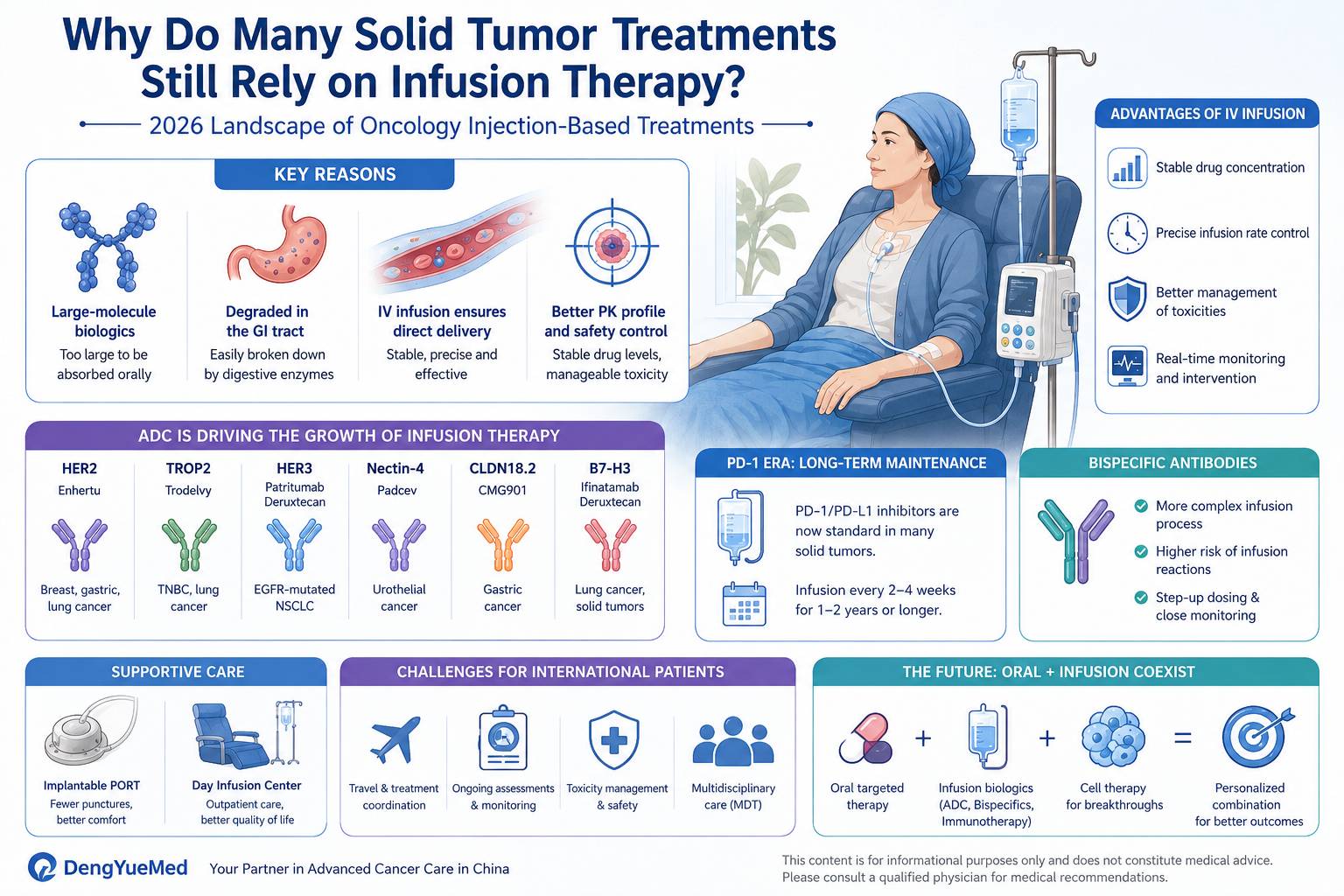
Over the past decade, oncology treatment has undergone a significant transition toward de-chemotherapy and oral targeted therapy. Oral targeted drugs against EGFR, ALK, ROS1, RET, BRAF, and KRAS G12C have enabled some solid tumors to evolve into long-term chronic disease management models, allowing many patients to receive treatment in outpatient clinics or even at home.
At the same time, however, another major trend has emerged. The most important innovative therapies that define the upper limit of advanced solid tumor treatment increasingly rely on intravenous infusion therapy.
By 2025–2026, the global treatment landscape for advanced solid tumors has clearly shifted toward:
- PD-1 / PD-L1 immunotherapy combinations
- Antibody-drug conjugates (ADCs)
- Bispecific antibodies
- Cell therapy combination regimens
- Multi-line sequential maintenance strategies
Nearly all of these advanced treatment approaches are built around long-term infusion-based administration.
Cancer treatment has therefore not moved toward complete oralization. Instead, it has entered a new era characterized by:
Long-Term Infusion + Long-Term Management + Multidisciplinary Care
For international patients, the challenge is no longer simply obtaining medication. Instead, successful treatment increasingly depends on the ability to:
- Sustain long-term multi-cycle infusion treatment
- Manage treatment-related toxicities
- Build stable cross-border follow-up systems
- Coordinate multidisciplinary cancer care
At DengYueMed, we continuously follow developments in China’s innovative oncology ecosystem—including ADCs, PD-1 therapies, bispecific antibodies, and cell therapies—while helping international patients better understand the rapidly evolving treatment landscape.
Why Do So Many Innovative Oncology Drugs Require Intravenous Infusion?
The Core Reason: Most Modern Solid Tumor Therapies Are Large-Molecule Biologics
Today’s fastest-growing oncology innovations primarily include:
- PD-1 / PD-L1 monoclonal antibodies
- Antibody-drug conjugates (ADCs)
- Bispecific antibodies
- Cytokine-based therapies
- CAR-T related conditioning regimens
- Tumor-targeted monoclonal antibodies
These therapies share several important biological characteristics:
- Large molecular size
- Complex three-dimensional structures
- Protein instability
- Susceptibility to degradation by digestive enzymes
Unlike small-molecule targeted drugs, these biologics cannot survive passage through the gastrointestinal tract or be reliably absorbed into the bloodstream after oral administration.
Consequently, intravenous infusion remains the safest and most effective method to deliver these therapies while ensuring:
- Stable systemic exposure
- Predictable pharmacokinetics
- Accurate dosing
- Consistent therapeutic activity
The ADC Boom Further Reinforces the Importance of Infusion Therapy
Among all modern oncology innovations, antibody-drug conjugates (ADCs) represent one of the fastest-growing therapeutic classes.
An ADC consists of three major components:
- A monoclonal antibody
- A chemical linker
- A highly potent cytotoxic payload
The antibody selectively recognizes tumor-associated antigens, transports the payload into cancer cells, and releases the cytotoxic drug after internalization.
This design enables:
- Highly targeted tumor killing
- Reduced systemic toxicity
- Improved therapeutic index
- Greater efficacy in selected cancers
Because ADCs are complex biologic medicines, they require carefully controlled intravenous administration to maintain optimal pharmacokinetic performance.
Major Global ADC Targets in 2026
| Target | Representative Drug | Major Indications |
|---|---|---|
| HER2 | Enhertu | Breast cancer, gastric cancer, NSCLC |
| TROP2 | Trodelvy | Triple-negative breast cancer, NSCLC |
| HER3 | Patritumab Deruxtecan | EGFR-mutated NSCLC |
| Nectin-4 | Padcev | Urothelial carcinoma |
| CLDN18.2 | CMG901 | Gastric cancer |
| B7-H3 | Ifinatamab Deruxtecan | Lung cancer, multiple solid tumors |
These ADCs universally rely on:
- Intravenous infusion
- Cyclical dosing schedules
- Long-term maintenance therapy
- Specialized infusion monitoring
Rather than reducing demand for infusion therapy, the rapid expansion of ADCs has significantly increased the need for specialized oncology infusion centers worldwide.
Today, ADCs are becoming standard treatments across multiple malignancies, including:
- Breast cancer
- Lung cancer
- Gastric cancer
- Urothelial carcinoma
- Gynecologic cancers
- Other advanced solid tumors
This trend is expected to continue as more next-generation ADCs receive regulatory approval over the coming years.
The Real Challenges of Long-Term Infusion Therapy for International Patients
For cross-border patients, the greatest challenge is maintaining treatment continuity throughout prolonged infusion-based therapy.
Key issues include:
Treatment Coordination
- International travel scheduling
- Multi-cycle infusion timing
- Long-term accommodation planning
Dynamic Monitoring Requirements
Patients receiving long-term biologic therapies generally require regular assessments, including:
- CT and MRI imaging
- PET-CT scans
- Genomic testing
- Biomarker monitoring
- Routine laboratory examinations
Toxicity Management
Long-term infusion therapies require careful monitoring for treatment-related adverse events, including:
- Pulmonary toxicity
- Hepatotoxicity
- Immune-related endocrine disorders
- Dermatologic toxicities
- CRS-like reactions
- Infusion-related reactions
Prompt recognition and management of these toxicities are essential to maintaining treatment continuity and patient safety.
Multidisciplinary Collaboration (MDT)
Modern oncology increasingly relies on multidisciplinary collaboration involving:
- Medical oncology
- Pulmonology
- Radiology
- Pathology
- Nutrition specialists
- Infectious disease physicians
- Oncology nursing teams
- Pharmacists
Comprehensive MDT care helps optimize treatment efficacy while improving quality of life throughout long-term therapy.
Growing Adoption of Implantable PORT Systems
As long-term infusion therapy becomes increasingly common, more patients are receiving implantable venous access devices (PORT systems).
Compared with repeated peripheral venous punctures, PORT systems provide several important advantages:
- Reduced repeated venipuncture
- Better vascular protection
- Improved patient comfort
- Lower risk of drug extravasation
- Greater convenience for long-term treatment
PORT systems are particularly beneficial for patients receiving:
- ADC therapies
- Long-term immunotherapy
- High-osmolarity medications
- Multi-drug combination regimens
For patients expected to undergo treatment for many months or years, PORT implantation has become an important component of supportive oncology care.
Day Infusion Centers Become Core Oncology Infrastructure
Large cancer centers around the world are rapidly expanding specialized day infusion centers.
Compared with traditional inpatient treatment models, day infusion centers offer numerous advantages:
- Outpatient-based management
- Same-day physician evaluation
- Same-day infusion therapy
- Post-infusion observation
- Reduced hospitalization
- Lower medical costs
- Improved quality of life
These centers have become an essential infrastructure supporting long-term biologic therapy, especially for patients receiving:
- PD-1 immunotherapy
- ADC therapy
- Bispecific antibodies
- Maintenance treatment
For international patients, day infusion centers also facilitate more flexible treatment scheduling and shorter hospital stays.
China’s Solid Tumor Infusion System Is Rapidly Internationalizing
China has experienced remarkable growth in oncology innovation over the past several years.
Major areas of development include:
- ADC clinical research
- PD-1 combination therapy
- Bispecific antibody development
- Cell therapy innovation
- International multicenter clinical trials
Meanwhile, leading Chinese cancer centers have established increasingly comprehensive international medical services, including:
- International patient departments
- MDT consultation platforms
- Specialized infusion nursing teams
- Day treatment centers
- Remote follow-up systems
- Multilingual patient support
These developments are making China an increasingly attractive destination for international patients seeking access to innovative cancer therapies.
Future Outlook: Oral Therapy and Infusion Therapy Will Coexist
The future of oncology treatment is unlikely to become completely oral.
Instead, experts anticipate a hybrid treatment model that combines:
Oral Targeted Therapy + Infusion-Based Biologics + Personalized Combination Regimens
In this integrated treatment paradigm:
- Small-molecule targeted drugs provide long-term precision inhibition of oncogenic pathways.
- ADCs deliver highly potent cytotoxic agents directly to tumor cells.
- Bispecific antibodies recruit immune cells to attack cancer.
- Immunotherapy supports durable disease control.
- Cell therapies offer potential breakthrough treatment for selected patients.
Rather than replacing infusion therapy, oral therapies and infusion-based biologics are expected to complement each other in personalized treatment strategies.
Conclusion
By 2026, solid tumor treatment is no longer simply about receiving chemotherapy.
Instead, modern oncology has evolved into a comprehensive treatment ecosystem characterized by:
- Long-term treatment cycles
- Precision medicine
- Multi-line combination strategies
- Dynamic disease monitoring
- Cross-border medical coordination
- Chronic disease-style management
For international patients, successful treatment increasingly depends on establishing a stable, continuous, and sustainable care pathway rather than simply obtaining access to medication.
DengYueMed continues to closely monitor developments in China’s innovative oncology therapies, including ADCs, PD-1 inhibitors, bispecific antibodies, and emerging cellular therapies. Through compliant pharmaceutical sourcing and international medical coordination, DengYueMed supports overseas patients seeking access to China’s rapidly evolving cancer treatment ecosystem.
Our services include:
- Information on leading Chinese cancer hospitals and oncology specialists
- International patient coordination
- Medical record organization and translation
- Information support for innovative Chinese oncology medicines
- Long-term infusion treatment coordination
- Remote medical assessment and cross-border healthcare assistance
As precision oncology continues to evolve, comprehensive treatment management—including access to innovative medicines, multidisciplinary expertise, and coordinated long-term care—will become increasingly important for improving survival outcomes and quality of life.
Frequently Asked Questions (FAQ)
Why are most modern cancer treatments given by infusion rather than as pills?
Most innovative cancer therapies—including monoclonal antibodies, antibody-drug conjugates (ADCs), bispecific antibodies, and many cellular therapies—are large biologic molecules that cannot survive digestion or be effectively absorbed through the gastrointestinal tract. Intravenous infusion ensures reliable delivery into the bloodstream while maintaining drug stability and effectiveness.
Which cancers commonly require long-term infusion therapy?
Long-term infusion therapy is widely used for many solid tumors, including:
- Non-small cell lung cancer (NSCLC)
- Breast cancer
- Gastric cancer
- Esophageal cancer
- Liver cancer
- Nasopharyngeal carcinoma
- Urothelial carcinoma
- Triple-negative breast cancer
- Melanoma
Many patients receive treatment every two to four weeks for one to two years or longer.
What is an ADC?
An antibody-drug conjugate (ADC) is a targeted cancer therapy consisting of:
- A monoclonal antibody
- A chemical linker
- A highly potent cytotoxic payload
The antibody selectively binds to tumor cells, allowing the chemotherapy payload to be delivered directly into cancer cells while reducing exposure to healthy tissues.
What is a PORT system?
A PORT (implantable venous access port) is a small device placed beneath the skin that provides long-term access to a central vein.
It helps reduce repeated needle sticks, protects peripheral veins, improves patient comfort, and facilitates repeated administration of infusion therapies.
Is China becoming a destination for advanced cancer treatment?
China has rapidly expanded its capabilities in precision oncology, including innovative drug development, ADC clinical research, immunotherapy, bispecific antibodies, and cellular therapies. Many leading cancer centers now provide international patient services, multidisciplinary treatment programs, and access to cutting-edge clinical trials, making China an increasingly important destination for selected international patients seeking advanced oncology care.
Disclaimer
This article is intended for educational and informational purposes only and does not constitute medical advice, diagnosis, or treatment recommendations.
Treatment decisions should always be made by qualified healthcare professionals based on each patient’s individual clinical condition, pathology, molecular profile, and treatment history.
Drug approvals, indications, and clinical practice may vary by country or region and continue to evolve as new clinical evidence becomes available.
Related Posts
- A New Option in Targeted Biologic Therapy: Clinical Insights into Guselkumab Injection
- Chinese HER2 Bispecific Antibody + PD-1 Combination Approved in the U.S. for Gastroesophageal Adenocarcinoma, Advancing to the Forefront of Global Oncology
- The 30-Year Chemotherapy Standard Faces a New Challenge: China's PD-1 Serplulimab Breaks New Ground in Gastric Cancer Treatment