China Pharmaceutical Distribution Industry Trends: Compliance Upgrades, Digital Transformation, and Supply Chain Opportunities in 2026
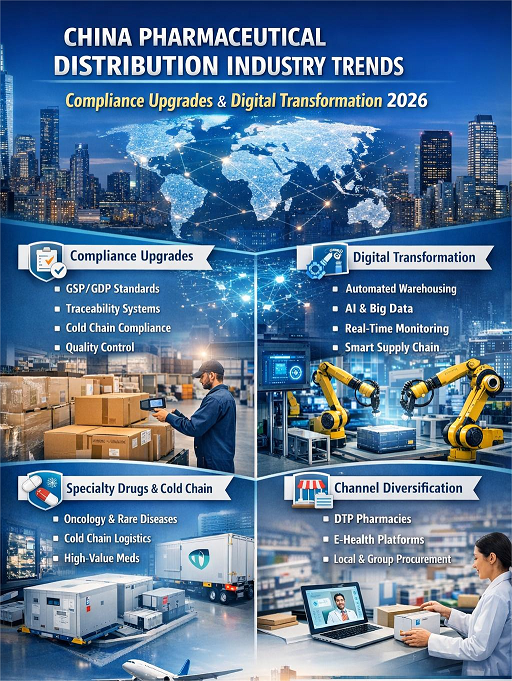
China Pharmaceutical Distribution Industry Trends Analysis
Against the backdrop of increasingly stringent pharmaceutical regulation, China’s pharmaceutical distribution industry is entering a new stage centered on compliance, digitalization, and supply chain resilience.
The traditional growth model driven mainly by channel expansion and scale is gradually being replaced by competition based on systematic operational capabilities.
As the industry structure continues to upgrade, more companies are strengthening their competitiveness through improved quality management systems and technology investment. Within this evolving ecosystem, companies such as DengYueMed are focusing on enhancing professional supply chain capabilities while optimizing operational efficiency.
China’s Pharmaceutical Distribution Industry Enters a Period of Structural Adjustment
In recent years, the overall size of China’s pharmaceutical distribution market has continued to expand. However, the logic behind industry growth is undergoing significant transformation.
With the implementation of major healthcare reforms such as:
- the Two-Invoice System
- volume-based procurement policies
- medical insurance cost-control mechanisms
profit margins within the distribution sector have become increasingly compressed. As a result, competition is rapidly shifting from scale expansion to capability-driven development.
Several structural trends are now shaping the industry:
- Increasing industry concentration
- Rising regulatory compliance requirements
- Hospitals remaining the primary demand center
- Accelerating digital infrastructure development
- Rapid growth in specialty drug and cold chain demand
Under these conditions, pharmaceutical distributors are gradually transitioning from “expansion-driven growth” to “system capability development.”
Compliance Upgrades Become a Core Industry Threshold
Compliance capability is becoming the primary determinant of long-term sustainability for pharmaceutical distributors.
Regulatory authorities are strengthening requirements related to:
- drug traceability systems
- quality management frameworks
- cold chain logistics standards
- distribution transparency
As a result, distributors must establish more robust GSP/GDP-compliant systems.
Key compliance priorities include:
- End-to-end electronic traceability
- Standardized quality management systems
- Cold chain temperature monitoring compliance
- Auditable and traceable logistics data
- Coordinated multi-warehouse compliance management
In response to these industry developments, DengYueMed continues to enhance its internal quality management systems, promoting standardization and transparency across the supply chain while reducing operational risks through proactive compliance strategies.
This compliance-first model is gradually becoming a defining direction for China’s pharmaceutical distribution sector.
Digital Transformation Reshapes Industry Competition
As operational complexity increases, digital transformation has emerged as a key differentiator among pharmaceutical distributors.
Leading companies are accelerating their transition toward smart supply chain systems, focusing investment in several areas:
- Automated warehousing and intelligent sorting
- AI-driven demand forecasting and inventory optimization
- Cloud-based pharmaceutical ordering platforms
- Real-time transportation and temperature monitoring
- Data-driven supply chain decision-making
Digital technologies not only improve operational efficiency but also significantly enhance transparency, traceability, and responsiveness across pharmaceutical supply networks.
These advancements are gradually transforming traditional pharmaceutical distribution models into data-driven supply chain ecosystems.
Specialty Drugs and Cold Chain Logistics Create New Growth Opportunities
Demand for specialty pharmaceuticals is rising rapidly, particularly in therapeutic areas such as:
- Oncology
- Autoimmune diseases
- Rare diseases
These high-value therapies typically require more sophisticated storage and distribution conditions, especially strict cold chain management.
As a result, distributors with the following capabilities are expected to gain competitive advantages:
- Multi-temperature cold chain logistics networks
- High-standard pharmaceutical quality systems
- Direct-to-provider delivery capabilities
- Stable multi-source drug procurement networks
In recent years, DengYueMed has continued to strengthen its cold chain logistics infrastructure, while improving standardized circulation processes for high-value medicines.
These improvements help enhance its specialized service capabilities in the global pharmaceutical supply chain.
Channel Diversification Is Driving New Distribution Models
China’s pharmaceutical distribution channels are also undergoing structural changes.
In addition to traditional hospital procurement systems, new distribution channels are expanding rapidly:
- Expansion of DTP pharmacies
- Growth of internet-based healthcare distribution
- Continued penetration into primary healthcare institutions
- Increasing centralized procurement by medical groups
Channel diversification is pushing pharmaceutical distributors to evolve beyond traditional wholesale models.
Modern distributors are increasingly transforming into integrated supply chain service platforms, combining:
- warehousing
- logistics
- data systems
- procurement networks
- professional service support
About DengYueMed
DengYueMed is a pharmaceutical supply chain service platform focused on providing compliant, reliable, and efficient drug supply solutions to global partners.
The company continues to strengthen:
- pharmaceutical quality management systems
- multi-source procurement networks
- cold chain logistics infrastructure
These efforts help enhance the overall resilience and stability of international pharmaceutical supply chains.
As China’s pharmaceutical distribution sector accelerates toward digitalization and specialization, DengYueMed is developing an operational model centered on compliance, efficiency, and supply chain optimization.
Future Opportunities: Operational Capabilities Will Define Industry Leaders
Looking ahead, competition within China’s pharmaceutical distribution industry will increasingly focus on comprehensive operational capabilities.
To remain competitive in the next development cycle, distributors are expected to prioritize:
- Strengthening compliance and quality management systems
- Expanding digital and automation investments
- Building resilient multi-source supply networks
- Increasing focus on specialty pharmaceuticals and cold chain logistics
- Enhancing service capabilities for healthcare providers
The industry is likely to continue consolidating toward leading players. However, the key differentiator will be the sophistication of each company’s operational system.
Conclusion
China’s pharmaceutical distribution industry is transitioning from scale-driven expansion to high-quality development.
Regulatory policy, digital technology, and evolving healthcare demand are jointly reshaping the industry’s underlying structure.
Amid these changes, companies that successfully integrate compliance excellence, digital capabilities, and resilient supply chain networks will be best positioned for long-term growth.
As the industry continues to evolve, DengYueMed aims to strengthen its professional competitiveness through enhanced compliance systems, digital supply chain development, and improved cold chain infrastructure—reflecting the broader transformation of China’s pharmaceutical distribution landscape.
Related Reading
For more insights into China’s pharmaceutical industry and oncology innovation, you may also read:
- China’s innovative drug global supply chain
- Chinese EGFR/MET targeted therapies for NSCLC
- Visit the homepage of DengYueMed for more global pharmaceutical industry insights.