Breast Cancer Screening Guide: What Should Women of Different Ages Do?
Breast cancer has become one of the most common cancers affecting women worldwide. In the past, many people associated breast cancer with poor outcomes, but advances in screening systems, imaging technologies, molecular diagnostics, and precision therapies have significantly improved early detection and survival rates.
Today, the outcome of breast cancer treatment depends not only on therapy itself, but also on one critical factor: early detection.
Studies continue to show that patients diagnosed at an early stage generally have far better survival outcomes than those diagnosed after the disease has progressed. As a result, modern breast cancer management is gradually shifting from “finding a lump and treating it” toward proactive screening, long-term monitoring, and personalized risk management.
As global attention toward women’s health, oncology innovation, and precision medicine continues to grow, DengYueMed remains focused on developments in international breast cancer screening, emerging therapies, and access to advanced treatment options through the evolving global healthcare ecosystem.
Why Breast Cancer Screening Is So Important
One of the most important characteristics of breast cancer is that early-stage disease may cause almost no symptoms.
Many patients:
- feel no pain,
- notice no obvious lump,
- and experience no significant discomfort.
In fact, some early breast cancers are detected only through imaging examinations.
This means:
“Feeling normal” does not necessarily mean “being risk-free.”
Some early lesions:
- are extremely small,
- grow slowly,
- and have not yet spread.
When discovered early:
- treatment is often less aggressive,
- breast-conserving surgery becomes more possible,
- and long-term survival rates improve significantly.
The true purpose of screening is to identify disease before symptoms appear.
Why Screening Strategies Change With Age
Breast cancer risk is not fixed throughout life.
As women age:
- hormonal environments change,
- genetic mutations accumulate,
- and breast tissue composition gradually shifts.
At the same time, breast density also changes with age.
Younger women often have:
- denser breast tissue,
while older women tend to have:
- higher fat composition.
These differences directly affect imaging accuracy and screening strategies.
This is why different age groups require different approaches to screening.
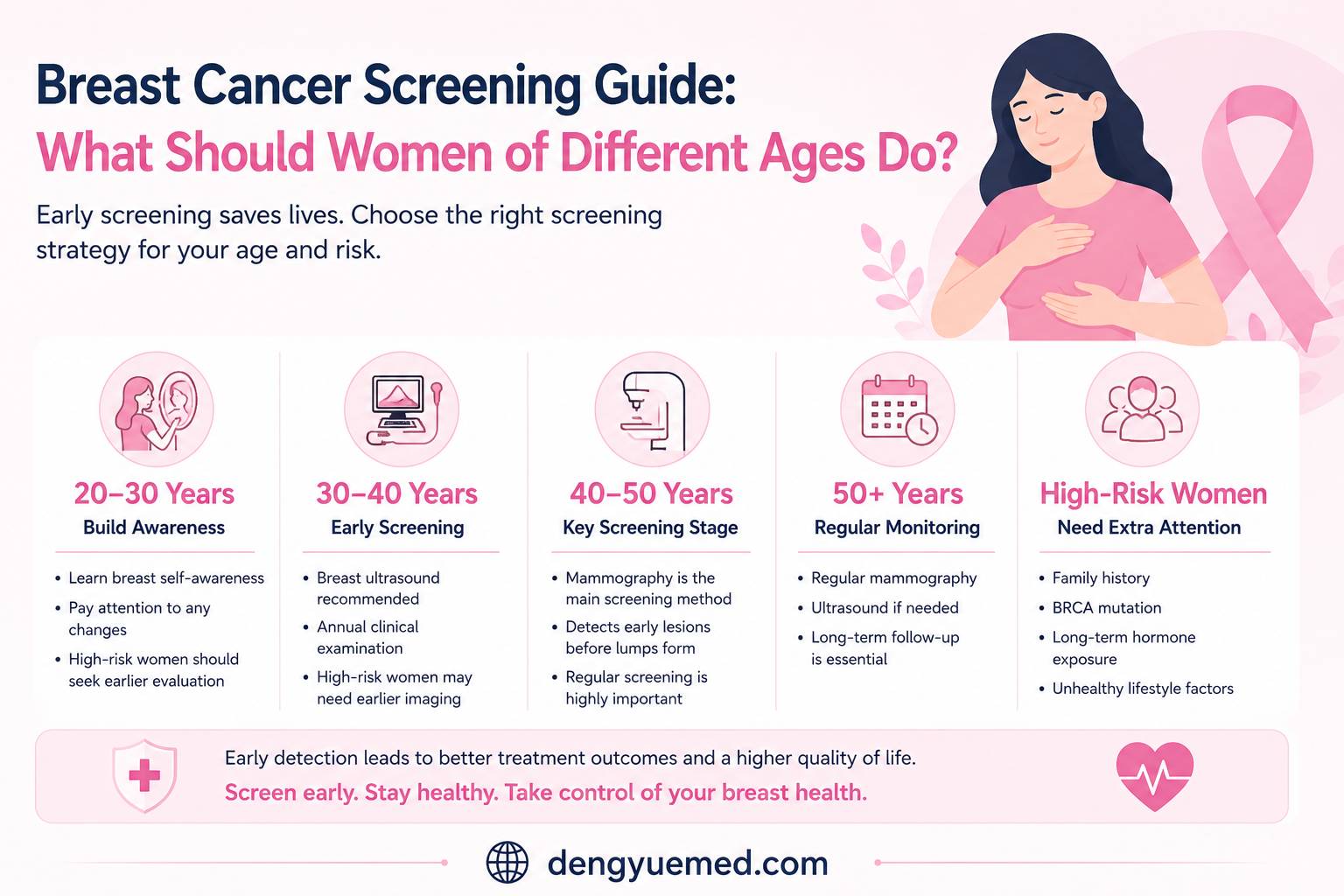
Ages 20–30: Building Breast Health Awareness
Overall breast cancer risk is relatively low during this stage of life.
However, younger women are not completely risk-free.
In recent years, the trend toward younger breast cancer patients has received increasing medical attention.
The Focus Is Not Frequent Mammography
Instead, the priority is developing long-term breast health awareness.
1. Learn Basic Breast Self-Awareness
Pay attention to:
- newly discovered lumps,
- thickened areas,
- nipple discharge,
- skin dimpling,
- or “orange peel” texture changes.
Many specialists recommend simple self-observation once a month after menstruation.
2. High-Risk Individuals Should Seek Earlier Assessment
Women with:
- a family history of breast cancer,
- BRCA-related family history,
- or prolonged hormonal exposure
may require earlier professional evaluation.
3. Persistent Changes Should Never Be Ignored
Many younger women believe:
“I’m too young to develop cancer.”
In reality, persistent abnormalities should always be evaluated carefully.
Ages 30–40: The Beginning of Increased Risk
During this stage, breast cancer incidence gradually begins to rise.
Factors such as:
- stress,
- lack of sleep,
- hormonal fluctuations,
- and reproductive history
may all influence breast health.
Recommended Screening Approaches
1. Breast Ultrasound
Ultrasound is often suitable for:
- dense breast tissue,
- and younger women.
Advantages include:
- no radiation exposure,
- and higher sensitivity in dense breasts.
2. Regular Clinical Examinations
Annual professional breast examinations are generally recommended.
3. Earlier Imaging for High-Risk Women
Some high-risk individuals may need earlier access to:
- mammography,
- or MRI screening.
Ages 40–50: A Critical Screening Stage
This age group receives particular attention in many international screening guidelines because breast cancer incidence rises more significantly.
Mammography Remains One of the Most Important Screening Tools
Mammography can detect:
- microcalcifications,
- early lesions,
- and cancers before a noticeable lump forms.
Many early-stage breast cancers are first identified through routine mammography.
Why Screening Matters So Much During This Period
Some patients:
- have absolutely no symptoms.
In many cases, the greatest danger is not “finding a lump,” but rather:
never being screened before symptoms appear.
Age 50 and Above: Long-Term Monitoring Matters More Than One Normal Result
Many women assume:
“My previous exam was normal, so I’m safe.”
However, breast cancer risk often continues increasing with age.
For this reason, consistent screening matters more than a single normal test.
Recommended strategies may include:
- regular mammography,
- ultrasound when necessary,
- and long-term follow-up.
Postmenopausal women should pay particular attention to ongoing risk changes.
Who Belongs to the High-Risk Population?
The following groups should take screening especially seriously:
1. Family History of Breast Cancer
Particularly when first-degree relatives such as:
- mothers,
- sisters,
- or daughters
have been diagnosed.
2. BRCA Mutation Carriers
These individuals face significantly higher lifetime risk and may require:
- earlier screening,
- more frequent monitoring,
- or specialized prevention strategies.
3. Long-Term Hormonal Factors
Examples include:
- prolonged estrogen exposure,
- late menopause,
- no childbirth history,
- or long-term hormone therapy.
4. Lifestyle and Obesity-Related Risks
Including:
- lack of exercise,
- high-fat diets,
- and excessive alcohol consumption.
Does Breast Self-Examination Still Matter?
There is ongoing debate surrounding self-examination.
In reality:
self-examination should never replace professional screening.
However, it still plays an important role.
Many patients initially seek medical attention because they:
- noticed unusual changes,
- detected skin abnormalities,
- or observed nipple changes themselves.
What matters most is understanding that:
a “normal” self-exam does not guarantee the absence of risk.
How Breast Cancer Treatment Is Changing
In the past, breast cancer treatment relied mainly on:
- surgery,
- chemotherapy,
- and radiation therapy.
Today, treatment strategies are rapidly evolving.
1. Targeted Therapy
For example, HER2-targeted treatments have significantly improved outcomes for certain patients.
2. Endocrine Therapy
Used for hormone receptor-positive breast cancers.
3. ADC Therapies and Precision Medicine
In recent years, antibody-drug conjugates (ADCs) and other innovative drugs have transformed treatment possibilities.
Modern breast cancer management increasingly focuses on:
- molecular classification,
- personalized treatment pathways,
- and long-term disease management.
Different patients may now receive completely different treatment strategies based on genetic and molecular characteristics.
Screening Changes More Than Survival Rates
Many people believe screening only helps “find disease earlier.”
In reality, early detection also influences:
- surgical options,
- treatment intensity,
- side effects,
- psychological stress,
- and long-term quality of life.
Earlier diagnosis often means a greater chance of maintaining normal daily life.
Conclusion: Women’s Health Management Should Begin Before Problems Appear
The true danger of breast cancer is not only the disease itself, but also the lack of long-term screening awareness among many women.
From developing health awareness in the 20s to maintaining regular imaging examinations after 40, each stage of life requires different priorities. Screening is not about creating fear — it is about gaining more control before disease progresses.
As breast cancer treatment enters an era of precision medicine, molecular testing, and individualized therapy, global attention toward innovative drugs, targeted oncology care, and international pharmaceutical accessibility continues to grow.
DengYueMed will continue following international trends in breast cancer screening, women’s health management, and next-generation cancer therapies across the global healthcare landscape.