Is CAR-T Therapy in China Open to International Patients?
Introduction
In recent years, CAR-T cell therapy has become one of the most closely watched innovative treatment technologies in the global oncology field.
Especially for patients with relapsed or refractory hematologic malignancies, CAR-T therapy is bringing new hope to those who have limited response to conventional treatment options.
In the past, when people mentioned cell therapy, they often first thought of countries such as the United States, Japan, or those in Europe.
However, with the rapid development of China’s biopharmaceutical industry, continuous breakthroughs in innovative medical technologies, and the gradual improvement of international medical service systems, more overseas patients are beginning to turn their attention to China.
Particularly in areas such as:
- Leukemia
- Lymphoma
- Multiple myeloma
The development speed of CAR-T therapy in China has attracted widespread international attention in recent years.
At the same time, questions such as:
- “Can international patients travel to China for CAR-T therapy?”
- “Is CAR-T treatment in China open to overseas patients?”
have gradually become major topics in cross-border healthcare discussions.
What Is CAR-T Therapy?
The full name of CAR-T is:
Chimeric Antigen Receptor T-Cell Therapy
It is a form of cellular immunotherapy whose core principle is to modify a patient’s own immune cells so they can more precisely recognize and attack cancer cells.
Unlike traditional chemotherapy, CAR-T therapy focuses more on targeted immune recognition.
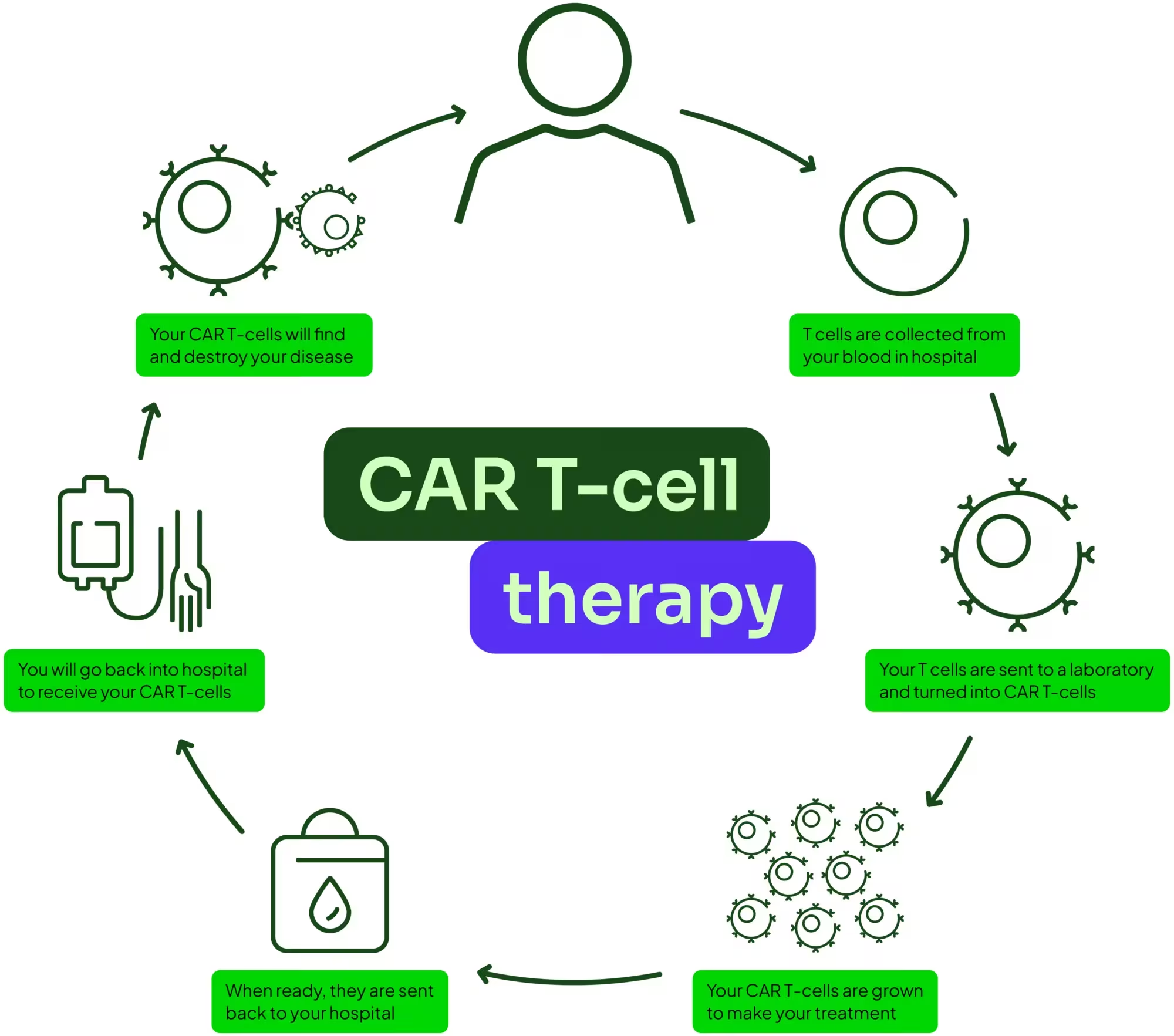
Doctors first collect T cells from the patient’s body.
These immune cells are then genetically engineered in a laboratory to give them the ability to recognize tumor cells.
After expansion, the modified cells are infused back into the patient’s body.
These engineered immune cells can actively seek out and attack cancer cells, which is why CAR-T is considered one of the most important representatives of precision medicine and immunotherapy in recent years.
Currently, CAR-T therapy is mainly used for:
- Acute Lymphoblastic Leukemia (ALL)
- Diffuse Large B-Cell Lymphoma (DLBCL)
- Multiple Myeloma (MM)
- Certain relapsed or refractory hematologic malignancies
In recent years, CAR-T research targeting solid tumors has also advanced rapidly.
Why Are More International Patients Paying Attention to CAR-T Therapy in China?
Over the past few years, China’s development in the CAR-T field has progressed rapidly.
In areas such as:
- Number of CAR-T clinical studies
- Development of new therapeutic targets
- Hospital treatment experience
- Cell therapy platform construction
- Industrialization capabilities
China has already become an important participant in the global cell therapy industry.
Especially in fields including:
- Dual-target CAR-T
- Universal CAR-T
- Solid tumor CAR-T
- CAR-NK
- Next-generation cellular immunotherapy
China’s pace of innovation continues to accelerate.
For some international patients, China represents not only a new treatment option, but also access to more innovative therapeutic opportunities.
Why Are Some Overseas Patients Choosing to Receive CAR-T Therapy in China?
In recent years, global cross-border healthcare has developed rapidly.
For some patients, challenges in their home countries may include:
- Long waiting periods
- High treatment costs
- Limited availability of therapies
- Insufficient medical resources
As a result, increasing numbers of patients are beginning to explore international medical resources.
At the same time, China’s international healthcare service system continues to improve.
Currently, more Chinese medical institutions have started establishing:
- International medical centers
- Multilingual service systems
- Overseas medical record evaluation services
- International patient coordination
- Remote consultation support
International oncology institutions represented by GuangZhou RoyalLee Cancer Hospital have also begun receiving patients from different countries and regions while strengthening cross-border healthcare capabilities.

Some institutions are now able to provide integrated support ranging from medical record evaluation and treatment consultation to travel coordination for treatment in China.
For overseas patients, this type of international medical service capability is gradually reducing communication barriers during cross-border treatment.
What Is the Typical Process for International Patients Seeking CAR-T Therapy in China?
For overseas patients, CAR-T therapy usually requires a comprehensive medical evaluation process before treatment begins.
Step 1: Remote Medical Record Evaluation
Patients are usually required to submit:
- Pathology reports
- Blood test results
- Genetic testing information
- Previous treatment records
- CT, MRI, or PET-CT imaging data
The medical team then conducts a preliminary assessment based on the patient’s condition.
This is important because not all patients are suitable candidates for CAR-T therapy.
Step 2: Specialist Consultation and Eligibility Assessment
If the initial evaluation meets treatment criteria, further arrangements may include:
- Hematology-oncology specialist consultation
- CAR-T eligibility analysis
- Risk assessment
- Treatment plan discussion
Patients also need to understand the potential side effects and treatment risks.
Step 3: Medical Travel Arrangements to China
After confirming the treatment plan, international patients usually need to prepare:
- Medical visa applications
- Medical invitation letters
- Travel arrangements
- Medical interpretation services
- Accommodation coordination
Cross-border treatment requires extensive communication and coordination beyond medical care itself.
As a result, more international patients are seeking assistance through professional cross-border healthcare service platforms.
Platforms such as DengYueMed help overseas patients connect more efficiently with Chinese medical resources, including:
- Hospital consultations
- Medical record communication
- International patient coordination
- Cross-border healthcare support
This collaborative model of “medical institutions + international service platforms” is becoming an important direction in China’s cross-border healthcare development.
What Issues Should Be Considered During CAR-T Therapy?
Although CAR-T therapy represents one of the most significant breakthroughs in cancer treatment in recent years, it is not suitable for every patient.
Safety Concerns
CAR-T therapy may involve risks such as:
- Cytokine Release Syndrome (CRS)
- Neurological-related reactions
- Infection risks
Therefore, strict management by experienced medical teams is essential.
Treatment Cost Concerns
Depending on the hospital, treatment plan, and patient condition, overall costs may vary significantly.
Patients usually need to understand in advance:
- Treatment costs
- Length of hospitalization
- Follow-up monitoring expenses
- Rehabilitation management costs
Whether the Treatment Is Suitable
CAR-T therapy is mainly intended for specific disease types.
Whether a patient is eligible for treatment must be comprehensively evaluated by professional doctors.
Not all cancer patients are suitable candidates for CAR-T therapy.
Future Development Trends of CAR-T in China
In recent years, China’s cell therapy industry has been developing rapidly.
In the future, the CAR-T field in China may continue advancing toward:
- Solid tumor CAR-T
- Universal CAR-T
- Lower side-effect treatment approaches
- AI-assisted cell therapy
- CAR-NK therapy
- International medical collaboration
As China’s cross-border healthcare system continues to improve, international patients’ interest in China’s innovative treatment resources is steadily increasing.
In the future, China may not only become a major global research center for cell therapy, but also gradually emerge as an important medical destination for international patients.
Conclusion
CAR-T therapy is changing the treatment landscape for some cancer patients and represents an important development direction in modern precision medicine and cellular immunotherapy.
In recent years, China’s development in CAR-T and cell therapy has attracted global attention.
From scientific innovation and clinical application to the construction of international patient service systems, China is drawing increasing attention from overseas patients.
For international patients, whether CAR-T therapy is appropriate still requires comprehensive evaluation by professional medical teams based on the individual condition.
However, as China’s international healthcare service capabilities continue to improve and cross-border healthcare systems gradually mature, China may play an increasingly important role in the global cell therapy field in the future.
Related Posts
- A New Option in Targeted Biologic Therapy: Clinical Insights into Guselkumab Injection
- Chinese HER2 Bispecific Antibody + PD-1 Combination Approved in the U.S. for Gastroesophageal Adenocarcinoma, Advancing to the Forefront of Global Oncology
- The 30-Year Chemotherapy Standard Faces a New Challenge: China's PD-1 Serplulimab Breaks New Ground in Gastric Cancer Treatment