Global Counterfeit Drugs and CAR-T Scams: How Gray Market Channels Threaten Cancer Patient Safety
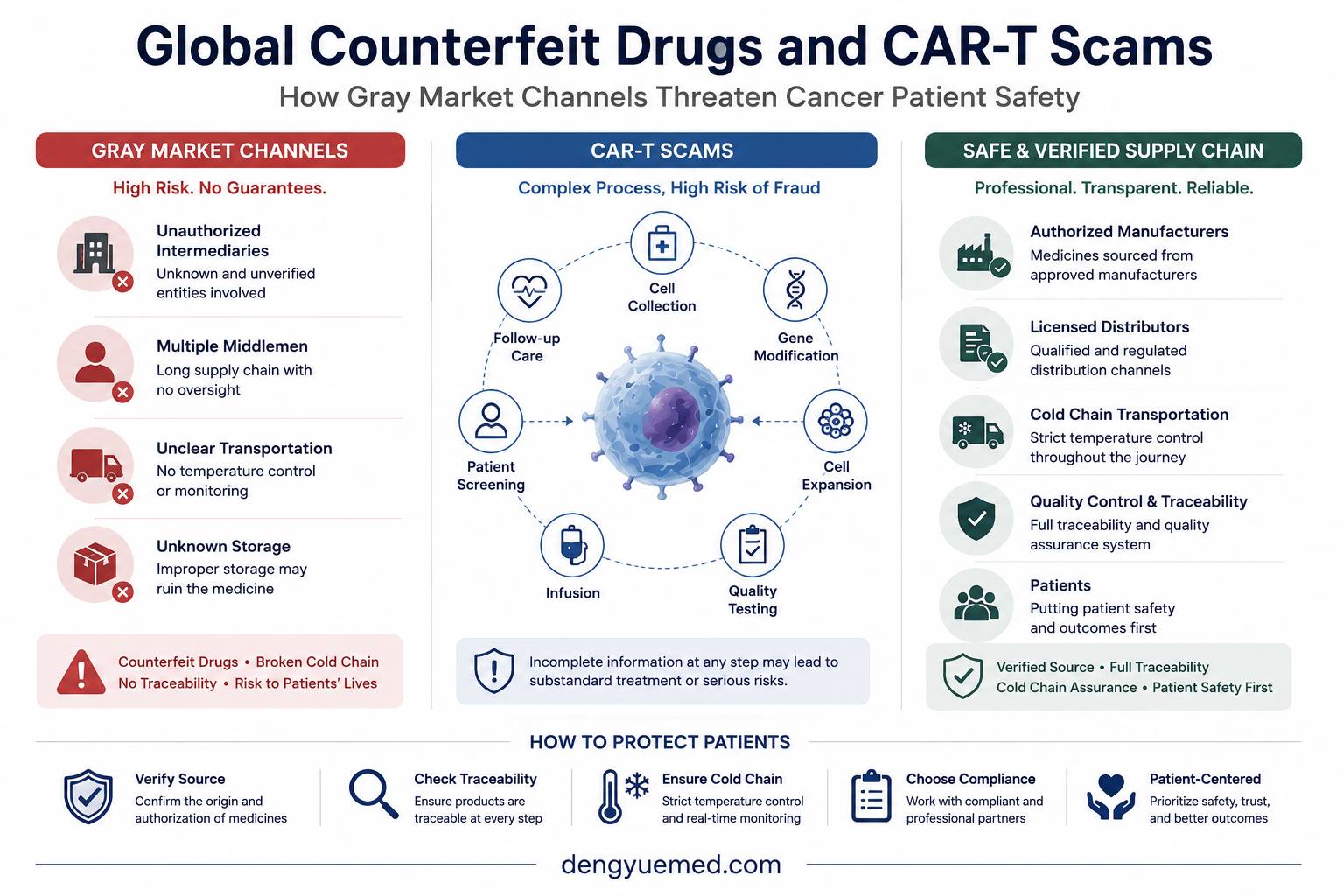
The issue of counterfeit drugs is no longer confined to traditional black markets; it has gradually infiltrated the complex links of the global pharmaceutical supply chain. With the growth of cross-border medical care and online drug purchasing, patients face significantly increased challenges in verifying product authenticity.
Data from the World Health Organization (WHO) Global Surveillance System shows that substandard and falsified medical products continue to appear worldwide, particularly in high-value therapeutic areas such as anticancer drugs and anti-infective medications.
For cancer patients, the core issue goes beyond “whether the drug is fake.” It lies in whether the drug can be effectively verified and whether the entire supply system is transparent and traceable.
Hidden Risks from Extended Supply Chains
Traditional pharmaceutical distribution may involve the following links:
Formal hospital or pharmaceutical company supply system → regional distributors → secondary dealers → unauthorized intermediaries → patients
As the chain lengthens, transparency of the drug’s origin gradually decreases. This risk is particularly prominent for biologics and cell therapy products.
CAR-T cell therapy, PD-1 immune checkpoint inhibitors, monoclonal antibodies, and certain specialized anticancer drugs have extremely high requirements for transportation and storage conditions. They require strict temperature-controlled environments, real-time monitoring, and complete traceability mechanisms.
Even if a drug originates from a legitimate channel, cold chain interruptions, storage failures, or packaging changes can lead to quality degradation or loss of efficacy.
Therefore, drug authenticity is not the only standard — a complete, transparent, and traceable supply system is equally critical.
Why CAR-T Has Become a High-Risk Area for Scams
CAR-T (Chimeric Antigen Receptor T-cell therapy), as one of the most discussed tumor immunotherapy technologies in recent years, has indeed brought treatment breakthroughs for some patients with relapsed or refractory hematologic malignancies.
However, its high technical complexity and expensive cost also make it easy for unscrupulous organizations to package and hype.
Some institutions frequently use promotional language such as:
- “Overseas latest CAR-T technology”
- “No waiting, fast infusion”
- “Success rate over 90%”
- “Special channel direct treatment”
While these statements sound professional, they ignore the integrity of standard CAR-T treatment.
Standard CAR-T Treatment Requires Multiple Critical Steps
A legitimate CAR-T treatment process typically includes:
- Patient screening
- Cell collection
- Laboratory gene modification
- Cell expansion
- Quality testing
- Infusion
- Long-term follow-up
The entire process relies on:
- GMP production systems
- Strict cold-chain transportation
- Identity tracking systems
- Multiple quality-control measures
- Regulatory oversight
When any link lacks complete information, patients may find it difficult to determine whether they are receiving standardized treatment or a high-risk simplified version.
Real Cases and Industry Data Warnings
In 2019, the WHO issued a global alert after a batch of counterfeit leukemia drugs entered markets in multiple countries.
These fake drugs had packaging highly similar to the original products, but laboratory testing revealed their active ingredient was merely ordinary acetaminophen, containing no anticancer components at all.
Patients may have believed they were receiving effective treatment for weeks or even months, only to suffer serious delays in real treatment.
WHO Global Surveillance System reports indicate that incidents of falsified and substandard medical products are increasing globally, covering critical categories such as:
- Anticancer drugs
- Vaccines
- Anti-infective medications
- Specialty biologics
Another study found that among 1,510 documented pharmaceutical falsification incidents, counterfeit drugs had already penetrated legitimate supply chains rather than existing only in underground markets.
U.S. regulatory reports also indicate that approximately 96% of the world’s roughly 35,000 online pharmacies operate illegally.
These figures demonstrate that the problem is no longer whether counterfeit drugs exist — but rather how patients can avoid them.
Patients Need Certainty, Not Just Lower Prices
When conventional treatment options approach their limits, cancer patients often actively seek overseas innovative therapies.
At this stage, what patients care about most is not simply price, but multiple layers of certainty:
- Is the drug source clear?
- Are the distribution links traceable?
- Does transportation and storage meet standards?
- Can authenticity be independently verified?
- Is the supplier properly licensed?
What patients are purchasing is never just the medicine itself, but treatment opportunities, time windows, and future possibilities.
Drug safety is not only a product issue — it is fundamentally a matter of trust.
DengYueMed’s Positioning: Prioritizing Transparency and Safety
As demand for innovative drugs and cross-border medical services continues to grow, patients now have access to far more channels, yet the risks arising from information asymmetry have not diminished.
At DengYueMed, we believe that truly valuable service goes beyond simply delivering medication to patients.
More importantly, we help patients understand the medication and its supply pathway.
This includes:
- Drug source verification
- Supply-chain transparency assessment
- Channel compliance review
- Transportation monitoring
- Comprehensive information support
We consistently maintain that patients already bear the uncertainty brought by disease itself — medication should not become an additional source of risk.
From the patient’s perspective, we prioritize safety over speed and reduce gray-market risks through professional verification mechanisms.
How Patients Can Better Protect Themselves
Patients considering overseas innovative therapies or cross-border medication access should:
Verify the Source
Work only with:
- Licensed medical institutions
- Authorized distributors
- Verified pharmaceutical suppliers
Avoid Unrealistic Marketing Claims
Be cautious of statements such as:
- “Guaranteed cure”
- “Fast-track special access”
- “No regulatory approval needed”
- “Secret overseas channels”
Request Documentation
Patients should ask for:
- Product traceability information
- Batch numbers
- Transportation details
- Regulatory certifications
Prioritize Transparency Over Price
Extremely low prices may indicate:
- Gray-market sourcing
- Improper storage
- Counterfeit products
- Unverified treatment channels
Conclusion
In today’s increasingly complex global pharmaceutical supply chain, what cancer patients need is not just “access to medication,” but safe, reliable, and traceable medication.
Choosing a professional and transparent cross-border medical service platform is a critical step in reducing risks and protecting treatment opportunities.
As innovative therapies such as CAR-T, PD-1 immunotherapies, and targeted oncology drugs continue expanding globally, ensuring authenticity, compliance, and supply-chain transparency will become increasingly important for both patients and the pharmaceutical industry as a whole.
Related Posts
- Global Accessibility of Spinal Muscular Atrophy (SMA) Treatment: Current Status Analysis
- A New Breakthrough in Colorectal Cancer ADC Therapy: Trastuzumab Rezetecan Approved for HER2-Positive Colorectal Cancer in China
- Gastric Cancer Treatment Is No Longer Just About Chemotherapy: How Precision Medicine Is Shaping the Future | A Comprehensive Guide to HER2, CLDN18.2, and FGFR2b