Precisely Activating the Immune System: Why Are T-Cell Engagers Gaining So Much Attention?

Precisely Activating the Immune System: Why Are T-Cell Engagers Gaining So Much Attention?
In recent years, cancer immunotherapy has achieved remarkable breakthroughs. From PD-1/PD-L1 inhibitors to CAR-T cell therapies, the immune system has demonstrated tremendous potential in the fight against cancer. Among the many innovative treatment approaches, T-cell engagers (TCEs) have rapidly emerged as a major focus for global pharmaceutical companies, research institutions, and investors.
As multiple T-cell engager therapies receive regulatory approvals and new clinical data continue to be released, TCEs are increasingly viewed as the next major advancement in cancer treatment following immune checkpoint inhibitors and CAR-T therapy. But what exactly are T-cell engagers? How do they precisely activate the immune system? And why are they considered one of the most promising directions in oncology?
As a company dedicated to tracking global advances in innovative drug development and cancer treatment, Dengyue Pharma has observed that T-cell engagers have become one of the most active areas of research and development in the international biopharmaceutical industry, attracting significant investment from multinational pharmaceutical companies, biotechnology firms, and research organizations.
What Are T-Cell Engagers?
T-cell engagers are a class of innovative biologic therapies designed to simultaneously bind cancer cells and T cells.
Their core design is based on bispecific or multispecific antibody technology. One end of the molecule recognizes a specific antigen expressed on the surface of tumor cells, while the other end binds to the CD3 receptor on T cells, effectively bringing the two cell types into close proximity.
Under normal circumstances, T cells are capable of recognizing and eliminating abnormal cells. However, many tumors develop mechanisms that allow them to evade immune surveillance, making it difficult for T cells to identify and attack them.
T-cell engagers act as a bridge between cancer cells and T cells, enabling immune cells to more accurately locate tumor cells and rapidly initiate a cytotoxic response.
How Do T-Cell Engagers Work?
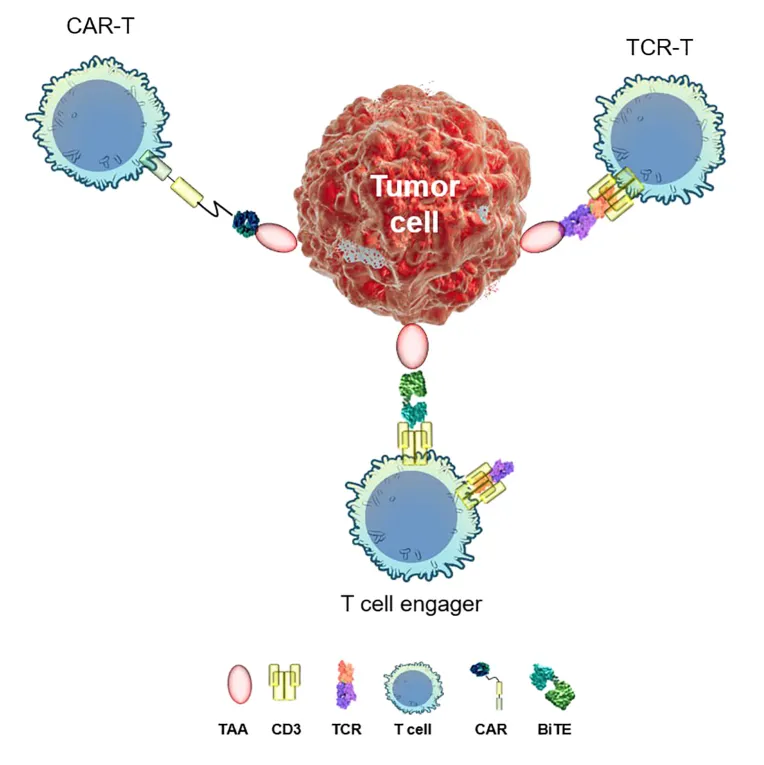
Comparison of CAR-T, TCR-T, and T-cell engager (TCE) mechanisms. T-cell engagers act as a bridge between T cells and tumor cells, enabling precise immune-mediated tumor killing through CD3 activation.
The mechanism of action of T-cell engagers can be summarized in three key steps.
Step 1: Recognizing Tumor Cells
The therapy first binds to specific antigens expressed on the surface of cancer cells, such as:
- BCMA (multiple myeloma)
- CD19 (B-cell malignancies)
- CD20 (lymphoma)
- DLL3 (small-cell lung cancer)
- HER2 (solid tumors)
These antigens help the drug precisely identify target cancer cells.
Step 2: Recruiting T Cells
At the same time, the other end of the molecule binds to CD3 receptors on T cells.
CD3 is one of the key receptors involved in T-cell activation. Once engaged, the drug rapidly recruits large numbers of T cells to the tumor site.
Step 3: Activating Cytotoxic Function
When T cells and cancer cells are brought into close contact, the T cells release cytotoxic molecules such as perforin and granzymes, triggering tumor cell death.
This process does not rely on the patient’s own antigen-presentation system, allowing for rapid and potent immune-mediated tumor killing.
Why Are T-Cell Engagers Receiving So Much Attention?
1. High Precision
Traditional chemotherapy often damages healthy tissues while targeting cancer cells.
In contrast, T-cell engagers are designed to target specific tumor antigens, improving treatment precision while reducing harm to normal cells.
As research into cancer biomarkers continues to advance, more highly specific targets are expected to be identified and utilized.
2. No Need for Complex Cell Manufacturing
Although CAR-T therapy has demonstrated impressive clinical efficacy, it requires collecting T cells from patients, genetically modifying them in specialized facilities, and reinfusing them into the patient.
This process is time-consuming, expensive, and logistically complex.
T-cell engagers, on the other hand, are considered “off-the-shelf” therapies. They can be manufactured in advance, stored, and administered directly without individualized cell engineering.
This advantage makes them more scalable and accessible for broader clinical use.
3. Potential to Address More Solid Tumors
CAR-T therapy has shown outstanding results in hematologic malignancies, but its effectiveness in solid tumors remains limited.
Because T-cell engagers can be designed to target a wide range of tumor-associated antigens, they are believed to have significant potential in treating solid tumors such as:
- Lung cancer
- Gastric cancer
- Breast cancer
- Colorectal cancer
This versatility is one of the primary reasons why pharmaceutical companies are investing heavily in the technology.
4. Strong Potential for Combination Therapy
A growing number of studies suggest that T-cell engagers may work synergistically when combined with:
- PD-1 inhibitors
- CTLA-4 inhibitors
- Antibody-drug conjugates (ADCs)
- Other immunotherapies
Such combination strategies may further improve response rates and long-term survival outcomes for cancer patients.
Significant Progress Has Already Been Achieved
In recent years, T-cell engager development has accelerated worldwide.
Several therapies have already received regulatory approval for hematologic cancers and have demonstrated encouraging clinical outcomes.
Particularly in relapsed or refractory multiple myeloma, acute lymphoblastic leukemia, and non-Hodgkin lymphoma, some patients have achieved durable responses.
At the same time, numerous next-generation T-cell engagers targeting solid tumors are advancing through clinical development.
Hundreds of clinical trials are currently underway globally, covering a wide range of cancers, including:
- Lung cancer
- Prostate cancer
- Ovarian cancer
- Gastric cancer
This intense research activity highlights the industry’s strong confidence in the potential of this therapeutic platform.
What Challenges Do T-Cell Engagers Face?
Despite their promising future, T-cell engagers still face several important challenges.
1. Cytokine Release Syndrome (CRS)
Because T-cell engagers can activate large numbers of T cells, some patients may experience inflammatory reactions such as fever, low blood pressure, and other symptoms associated with cytokine release syndrome.
However, improvements in dosing strategies and clinical management have significantly reduced these risks.
2. Target Selection Remains Difficult
An ideal target should be highly expressed on tumor cells while having minimal expression in healthy tissues.
Poor target selection may result in unintended damage to normal cells.
As a result, identifying safer and more tumor-specific antigens remains a major focus of research.
3. The Immunosuppressive Tumor Microenvironment
Solid tumors often create complex immunosuppressive environments that limit the ability of T cells to infiltrate tumors and function effectively.
Overcoming these barriers is considered one of the most important goals for future T-cell engager development.
How Could T-Cell Engagers Transform the Future of Cancer Treatment?
Cancer therapy is evolving from single-mechanism treatments toward multi-mechanism, integrated approaches.
T-cell engagers are uniquely positioned to connect different therapeutic strategies within a single platform.
Future T-cell engager therapies may combine:
- Tumor targeting
- Immune activation
- Tumor microenvironment modulation
- Precision biomarker selection
Researchers are increasingly exploring combinations of T-cell engagers with:
- PD-1 inhibitors
- Antibody-drug conjugates (ADCs)
- CAR-T therapies
- Cancer vaccines
As technologies continue to advance, T-cell engagers are expected to expand into additional cancer types and further improve long-term patient outcomes.
Why Are Pharmaceutical Companies Investing Heavily in TCE Platforms?
The global oncology market is increasingly moving toward precision medicine and immune-based therapies.
T-cell engagers offer several characteristics that make them attractive development platforms:
- Off-the-shelf availability
- Scalable manufacturing
- Flexible target selection
- Potential use across multiple cancer types
- Strong combination therapy potential
As a result, numerous multinational pharmaceutical companies and biotechnology firms are investing heavily in next-generation T-cell engager technologies, including bispecific and multispecific antibody platforms.
Many experts believe T-cell engagers may become one of the fastest-growing segments of cancer immunotherapy over the next decade.
Conclusion
From their unique mechanism of action to their expanding clinical applications, T-cell engagers are demonstrating enormous potential to transform cancer treatment.
By precisely connecting T cells with cancer cells and activating the body’s own immune defenses, T-cell engagers offer new hope for patients facing cancer.
As global research efforts continue to accelerate, more clinical data emerge, and additional products reach the market, T-cell engagers are expected to become one of the foundational pillars of future cancer immunotherapy, opening new possibilities in the era of precision medicine.
For pharmaceutical innovators, researchers, and healthcare providers worldwide, T-cell engagers represent one of the most exciting frontiers in oncology today.
Dengyue Pharma will continue monitoring global developments in T-cell engager therapies, bispecific antibodies, oncology innovation, and emerging immunotherapy technologies while supporting broader patient access to advanced cancer treatments through international pharmaceutical supply and healthcare collaboration.
Related Posts
- A New Option in Targeted Biologic Therapy: Clinical Insights into Guselkumab Injection
- Chinese HER2 Bispecific Antibody + PD-1 Combination Approved in the U.S. for Gastroesophageal Adenocarcinoma, Advancing to the Forefront of Global Oncology
- The 30-Year Chemotherapy Standard Faces a New Challenge: China's PD-1 Serplulimab Breaks New Ground in Gastric Cancer Treatment