Is a Trispecific Antibody Necessarily Better Than a Bispecific? An Analysis of Efficacy, Safety, and Future Applications
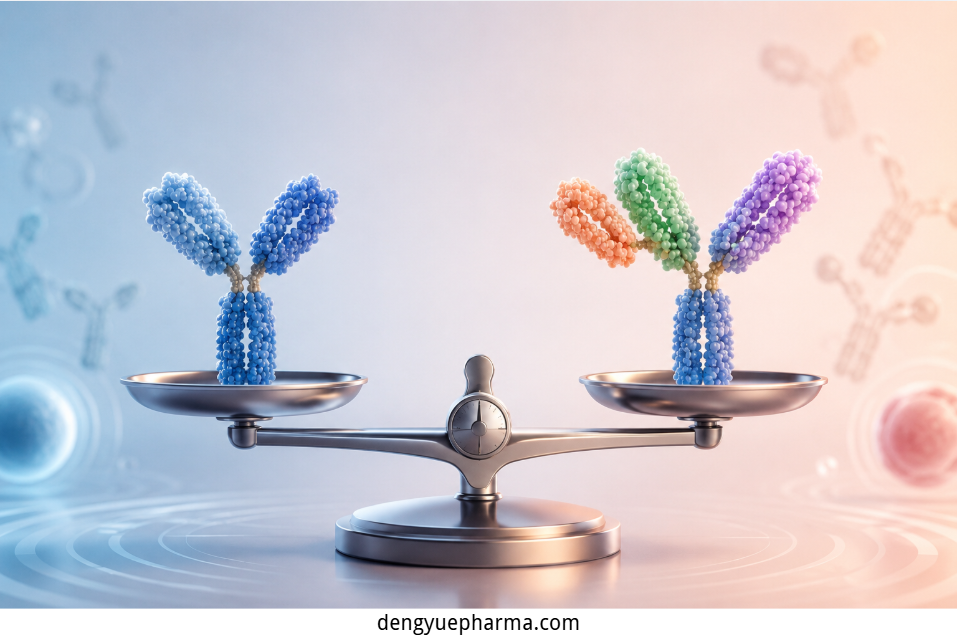
In recent years, bispecific antibodies (BsAbs) have become one of the most active areas of global innovative drug development. As antibody engineering technologies continue to advance, trispecific antibodies (TsAbs) are also rapidly entering clinical development. From hematologic malignancies and solid tumors to autoimmune diseases, an increasing number of biopharmaceutical companies are investing in trispecific antibody programs.
This has raised an important question across the industry:
Are trispecific antibodies always superior to bispecific antibodies?
The answer is not necessarily.
While trispecific antibodies feature more sophisticated molecular designs and additional potential mechanisms of action, their efficacy, safety, manufacturing complexity, and clinical utility must all be evaluated based on the specific molecule and disease indication.
At Dengyue Pharma, we closely follow the latest advances in antibody therapeutics and share professional medical insights to help industry partners better understand the future direction of next-generation biologics.
What Is the Difference Between Trispecific and Bispecific Antibodies?
A bispecific antibody is engineered to recognize two different targets simultaneously, whereas a trispecific antibody can bind to three distinct targets or functional epitopes.
Compared with conventional monoclonal antibodies, bispecific antibodies can already:
- Simultaneously bridge immune cells and tumor cells
- Block two disease-related signaling pathways
- Improve targeting precision
Trispecific antibodies introduce a third functional module, theoretically enabling multiple biological functions at the same time, such as:
- Simultaneous activation of multiple immune mechanisms
- Enhanced recognition of tumor cells
- Overcoming certain resistance mechanisms
- Remodeling the tumor microenvironment
Therefore, trispecific antibodies are not simply upgraded bispecific antibodies but represent a further evolution in molecular design strategy.
Do Trispecific Antibodies Deliver Better Efficacy?
At present, trispecific antibodies offer greater therapeutic potential, but they do not automatically guarantee superior efficacy over bispecific antibodies.
In theory, introducing a third target may improve treatment outcomes by:
- Targeting multiple tumor antigens simultaneously to reduce antigen escape
- Activating multiple immune effector cells, including T cells and NK cells
- Blocking several pathogenic signaling pathways at once
Numerous trispecific antibodies are currently being investigated in hematologic cancers, solid tumors, and autoimmune disorders. Early clinical studies have reported encouraging objective response rates (ORR) and duration of response (DoR) for some candidates.
However, significant differences remain among individual products.
Adding another target does not always translate into greater clinical benefit. Ultimately, the true value of trispecific antibodies will require confirmation through well-designed Phase III clinical trials.
Will Safety Become More Challenging?
Compared with bispecific antibodies, one of the biggest challenges for trispecific antibodies is safety management.
Because trispecific antibodies simultaneously regulate more immune pathways, they often induce stronger immune activation, potentially increasing the risk of immune-related adverse events, including:
- Cytokine release syndrome (CRS)
- Immune-mediated toxicities
- Hematologic adverse events
- Liver function abnormalities
- Neurological toxicities
To address these concerns, many developers are applying advanced engineering approaches, including:
- Affinity tuning
- Conditional activation technologies
- Half-life optimization
These strategies aim to maintain efficacy while minimizing toxicity.
Ultimately, the widespread clinical adoption of trispecific antibodies will depend on achieving an appropriate balance between efficacy and safety.
Why Is Developing Trispecific Antibodies More Challenging?
Although trispecific antibodies offer more theoretical advantages, their development is also significantly more difficult than that of bispecific antibodies.
1. More Complex Molecular Structure
The three binding sites must maintain stable expression while ensuring an appropriate spatial conformation. Otherwise, the drug’s biological activity and stability may be adversely affected.
2. Higher Manufacturing Requirements
Trispecific antibodies typically involve more complex protein folding, purification, and quality control processes, placing higher demands on manufacturing platforms.
3. More Complex Clinical Development
Because multiple mechanisms of action are involved, dose optimization, safety evaluation, biomarker selection, and patient stratification are all more challenging than for bispecific antibodies.
As a result, both development timelines and costs are correspondingly higher.
Therefore, trispecific antibodies are unlikely to completely replace bispecific antibodies. Instead, they are more likely to serve as an important complement in different therapeutic settings.
Which Therapeutic Areas May Benefit Most from Trispecific Antibodies?
Current global trispecific antibody development is primarily focused on several key areas.
Hematologic Malignancies
Blood cancers remain the most mature application area. Many candidates employ T-cell engager strategies to further enhance immune-mediated tumor cell killing.
Solid Tumors
Solid tumors present challenges such as complex tumor microenvironments, immune suppression, and antigen heterogeneity.
Multi-target trispecific designs may help overcome these barriers and improve treatment efficacy.
Autoimmune Diseases
Several companies are exploring trispecific antibodies capable of simultaneously regulating multiple inflammatory pathways to achieve better disease control.
Infectious Diseases
In the future, multi-target antibodies may also find applications in viral infections and drug-resistant bacterial infections by enhancing pathogen elimination.
As research progresses, the clinical applications of trispecific antibodies are expected to continue expanding.
Will Trispecific Antibodies Replace Bispecific Antibodies?
Based on current industry trends, the answer is probably not.
Instead, the two technologies are likely to coexist over the long term.
Bispecific antibodies already benefit from:
- Mature development platforms
- Extensive clinical experience
- Successful commercialization across multiple indications
Trispecific antibodies, on the other hand, appear better suited for highly complex diseases, resistant tumors, or conditions requiring multi-dimensional immune modulation.
Different antibody formats are expected to play complementary roles:
| Antibody Format | Primary Application |
|---|---|
| Monoclonal antibodies | Clearly defined single-target diseases |
| Bispecific antibodies | Most complex therapeutic needs |
| Trispecific antibodies | Highly difficult diseases and specialized clinical scenarios |
Consequently, the future of antibody therapeutics is unlikely to be defined simply by “more targets.”
Instead, success will depend on achieving the optimal balance among:
- Clinical efficacy
- Safety
- Manufacturability
- Accessibility
- Cost-effectiveness
Conclusion
Trispecific antibodies represent an important frontier in next-generation antibody therapeutics. However, they cannot yet be considered inherently superior to bispecific antibodies.
Whether they ultimately provide greater clinical benefit will depend on:
- Their specific target combinations
- Disease indications
- Clinical evidence
- Long-term safety profiles
As advances continue in protein engineering, artificial intelligence-driven drug design, and precision medicine, trispecific antibodies are expected to further expand the therapeutic boundaries of biologics, offering new treatment options for patients with cancer, autoimmune diseases, and infectious diseases.
Although trispecific antibodies have attracted significant attention, the future of antibody therapeutics will not be determined by the number of targets alone. Instead, success will come from designing molecules that deliver the best balance between efficacy, safety, manufacturability, and real-world clinical value.