Why Are Solid Tumors More Difficult to Treat Than Blood Cancers? Uncovering the Key Challenges Behind Cancer Therapy
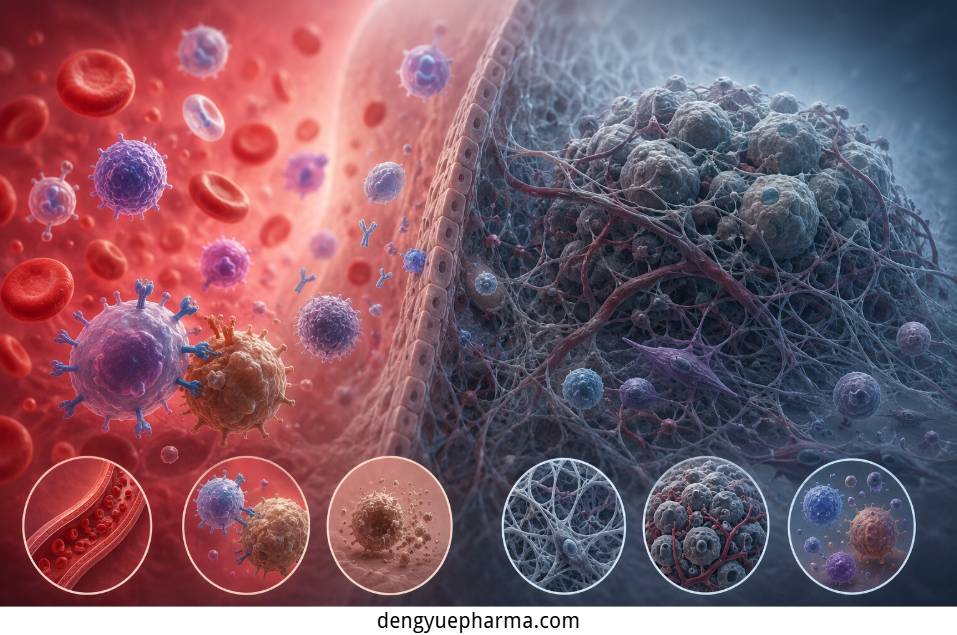
Uncovering the Key Challenges Behind Cancer Therapy
In recent years, innovative therapies such as CAR-T cell therapy, bispecific antibodies, and antibody-drug conjugates (ADCs) have transformed cancer treatment and offered new hope for patients worldwide.
However, one trend has become increasingly clear: therapeutic advances in hematologic malignancies have progressed much faster than those in solid tumors.
Many innovative treatments for leukemia, lymphoma, and multiple myeloma have demonstrated remarkable clinical outcomes, while common solid tumors—including lung, gastric, breast, liver, pancreatic, and colorectal cancers—remain considerably more difficult to treat.
Why are solid tumors so challenging, even though both are forms of cancer?
The answer lies in a combination of biological barriers, including the tumor microenvironment, immune evasion, drug delivery limitations, tumor heterogeneity, and the lack of ideal therapeutic targets.
What Are the Fundamental Differences Between Blood Cancers and Solid Tumors?
Cancer is generally classified into two major categories:
Hematologic Malignancies
These include:
- Leukemia
- Lymphoma
- Multiple myeloma
Cancer cells primarily reside in the blood, bone marrow, or lymphatic system, making them readily accessible to immune cells and circulating therapeutic agents.
Solid Tumors
Solid tumors form localized masses in organs and tissues and include cancers such as:
- Lung cancer
- Breast cancer
- Colorectal cancer
- Gastric cancer
- Liver cancer
- Pancreatic cancer
- Ovarian cancer
Solid tumors account for more than 90% of all malignant cancers and remain the leading cause of cancer-related deaths worldwide.
These biological differences largely explain why treatment strategies differ so dramatically.
Challenge 1: The Complex Tumor Microenvironment
One of the greatest obstacles in treating solid tumors is the tumor microenvironment (TME).
A solid tumor consists of much more than cancer cells.
It also contains:
- Cancer-associated fibroblasts (CAFs)
- Immunosuppressive immune cells
- Blood vessels
- Extracellular matrix (ECM)
- Inflammatory cytokines
- Various stromal components
Together, these elements create an environment that supports tumor growth while preventing immune cells from effectively infiltrating the tumor.
For example, even when CAR-T cells successfully circulate through the bloodstream, they often struggle to penetrate the dense tumor tissue.
By contrast, cancer cells in hematologic malignancies are directly exposed to circulating immune cells, making immune-mediated elimination considerably easier.
Challenge 2: Greater Tumor Heterogeneity
Solid tumors display remarkable tumor heterogeneity.
Even within a single tumor, different regions may contain cancer cells carrying distinct genetic mutations and expressing different tumor antigens.
Consequently, a therapy capable of eliminating one tumor cell population may leave others untouched, eventually leading to:
- Drug resistance
- Disease recurrence
- Treatment failure
Many hematologic malignancies originate from relatively homogeneous cell populations with more consistent therapeutic targets, allowing targeted therapies and cellular therapies to achieve higher response rates.
Challenge 3: Limited Drug Penetration
Delivering drugs uniformly throughout a solid tumor remains extremely difficult.
Several factors contribute to poor drug distribution, including:
- Abnormal blood vessels
- Uneven blood flow
- Dense stromal tissue
- High interstitial pressure
As a result, therapeutic agents often fail to reach sufficient concentrations within the tumor core.
To overcome this challenge, researchers are developing:
- Antibody-drug conjugates (ADCs)
- Nanoparticle drug delivery systems
- Localized drug delivery technologies
These approaches aim to improve drug penetration while minimizing systemic toxicity.
Challenge 4: Sophisticated Immune Evasion
Under normal conditions, the immune system continuously identifies and eliminates abnormal cells.
Solid tumors, however, develop multiple mechanisms to escape immune surveillance.
For example, tumor cells may:
- Express PD-L1 to suppress T-cell activity
- Recruit regulatory T cells (Tregs)
- Recruit myeloid-derived suppressor cells (MDSCs)
- Secrete immunosuppressive cytokines
Together, these mechanisms create an immunosuppressive environment that weakens antitumor immunity.
This also explains why immune checkpoint inhibitors have transformed treatment for several cancers while producing durable responses in only a subset of patients.
Challenge 5: The Lack of Ideal Therapeutic Targets
One reason CAR-T therapy has achieved remarkable success in hematologic malignancies is the availability of highly specific targets such as:
- CD19
- BCMA
Unfortunately, equivalent targets rarely exist in solid tumors.
Many candidate antigens are also expressed on healthy tissues.
Targeting these molecules may cause on-target, off-tumor toxicity, increasing the risk of severe adverse events.
Identifying safer and more tumor-specific targets therefore remains one of the most active areas of oncology research.
Innovative Therapies Are Driving New Breakthroughs
Despite these challenges, innovative technologies continue to reshape the treatment landscape for solid tumors.
Several promising approaches include:
Antibody-Drug Conjugates (ADCs)
ADCs deliver highly potent cytotoxic drugs directly to tumor cells while minimizing damage to healthy tissues.
Bispecific Antibodies
Bispecific antibodies simultaneously recognize two different targets, enhancing immune cell-mediated tumor killing.
Emerging Cell and Immune Therapies
Rapidly advancing technologies include:
- Tumor-infiltrating lymphocyte (TIL) therapy
- T-cell receptor-engineered T-cell (TCR-T) therapy
- Oncolytic viruses
- Personalized cancer vaccines
Meanwhile, advances in artificial intelligence, bioinformatics, multi-omics analysis, and spatial transcriptomics are providing researchers with unprecedented insights into tumor biology, enabling increasingly precise therapeutic strategies.
Conclusion
Solid tumors are more difficult to treat than hematologic malignancies not because any single therapy is ineffective, but because multiple biological barriers work together to limit treatment success.
A complex tumor microenvironment, significant tumor heterogeneity, poor drug penetration, sophisticated immune evasion mechanisms, and the lack of highly specific therapeutic targets all contribute to the challenge.
Nevertheless, rapid advances in innovative therapies—including antibody-drug conjugates (ADCs), bispecific antibodies, CAR-T therapy, TCR-T therapy, and personalized cancer vaccines—are steadily transforming the treatment landscape.
As precision medicine, molecular diagnostics, and next-generation drug delivery technologies continue to evolve, future therapies are expected to become increasingly targeted, personalized, and effective, offering improved outcomes for patients with solid tumors.
Related Posts
- What Do RET and BRAF Gene Changes Mean in Thyroid Cancer?
- New Progress in First-Line Treatment of HER2-Positive Breast Cancer: Trastuzumab Deruxtecan Plus Pertuzumab Approved
- A New Breakthrough in Colorectal Cancer ADC Therapy: Trastuzumab Rezetecan Approved for HER2-Positive Colorectal Cancer in China