Why Are Trispecific Antibodies More Complex Than Bispecific Antibodies? Understanding the Design Logic Behind Trispecific Antibodies
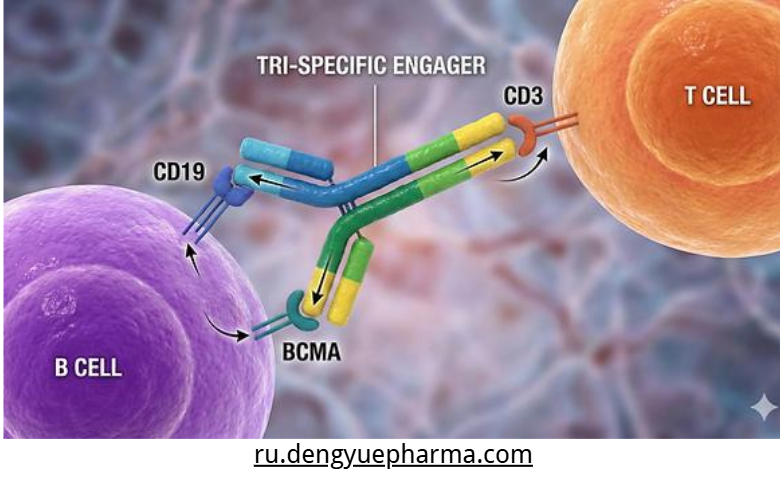
Understanding the Design Logic Behind Trispecific Antibodies
In recent years, the rapid development of bispecific antibodies (BsAbs) has propelled cancer immunotherapy into a new era. From hematologic malignancies to solid tumors, an increasing number of bispecific antibody therapies have entered clinical development, with several already receiving regulatory approval.
As antibody engineering continues to evolve, researchers have begun pushing beyond dual-target designs. Trispecific antibodies (TsAbs) have emerged as one of the most promising next-generation antibody technologies, aiming to overcome several limitations associated with conventional bispecific antibodies.
So, what exactly makes trispecific antibodies different? Why does adding just one additional target dramatically increase development complexity?
The answer lies not merely in having three binding sites, but in a fundamentally different approach to antibody engineering.
Why Were Trispecific Antibodies Developed?
One of the greatest advantages of bispecific antibodies is their ability to bind two different targets simultaneously.
A typical T-cell engager (TCE), for example, uses one binding arm to recognize a tumor-associated antigen while the other binds the CD3 receptor on T cells. This molecular bridge brings immune cells directly into contact with cancer cells, enabling efficient immune-mediated tumor killing.
This strategy has already demonstrated remarkable clinical success in several hematologic malignancies.
However, important challenges remain.
Tumor cells are highly heterogeneous and may gradually lose expression of the target antigen during treatment, resulting in antigen escape and reduced therapeutic efficacy.
In addition, activation through CD3 alone does not always generate sufficiently durable immune responses. In solid tumors, an immunosuppressive tumor microenvironment further limits treatment effectiveness.
To address these limitations, researchers sought to integrate multiple biological functions into a single therapeutic molecule.
This concept gave rise to trispecific antibodies.
The Real Complexity Lies in the Design Strategy
Many people assume that a trispecific antibody is simply a bispecific antibody with one extra binding domain.
In reality, the addition of a third target fundamentally changes the overall design philosophy.
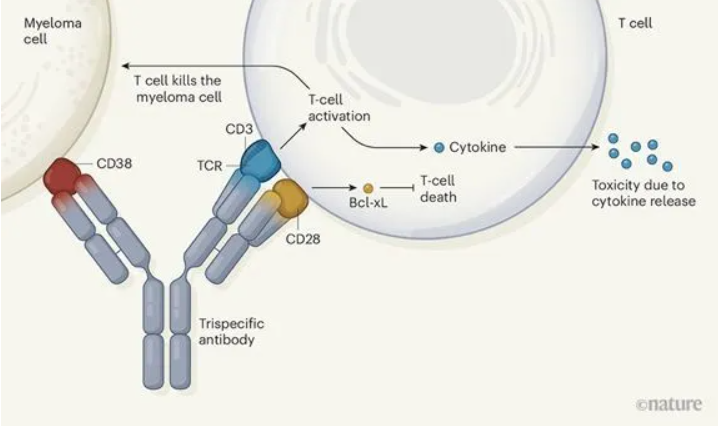
Today, several trispecific antibody strategies are under active investigation.
One approach simultaneously targets two tumor-associated antigens together with one immune target, helping reduce antigen escape while expanding tumor coverage.
Another strategy combines one tumor antigen with two immune co-stimulatory receptors, such as CD3 and CD28, to strengthen and prolong T-cell activation.
Other trispecific antibodies are designed to regulate multiple immunosuppressive pathways simultaneously, thereby remodeling the tumor microenvironment and improving therapeutic responses in solid tumors.
In other words, the third target is not simply an additional function.
It introduces an entirely new biological role, allowing one antibody molecule to accomplish tasks that previously required multiple separate therapies.
Why Is Developing Trispecific Antibodies More Challenging?
Developing trispecific antibodies presents major challenges throughout antibody engineering.
More Complex Molecular Design
Three independent binding domains must maintain a stable three-dimensional structure while avoiding interference with one another.
Each target requires careful optimization of:
- Binding affinity
- Spatial orientation
- Molecular flexibility
- Binding sequence
Poor structural design may compromise both biological activity and molecular stability.
Balancing Three Biological Functions
One of the greatest engineering challenges is balancing the biological activities of all three targets.
Greater immune activation does not necessarily produce better clinical outcomes.
For example:
- Excessive CD3 activation may increase the risk of cytokine release syndrome (CRS).
- Insufficient tumor-target affinity may reduce antitumor efficacy.
- Improper coordination among the three targets may narrow the therapeutic window.
Achieving the optimal balance between efficacy and safety is therefore considerably more difficult than in bispecific antibody development.
Higher Manufacturing Complexity
Manufacturing trispecific antibodies is substantially more demanding than producing bispecific antibodies.
Every stage becomes more technically challenging, including:
- Cell-line development
- Protein expression
- Protein folding
- Purification
- Analytical characterization
- Quality control
These manufacturing challenges contribute to longer development timelines and significantly higher production costs.
Will Trispecific Antibodies Replace Bispecific Antibodies?
Based on current evidence, the answer is probably not.
Although several trispecific antibody candidates have reported encouraging early clinical results, most remain in Phase I or Phase II clinical trials.
Large randomized Phase III studies are still needed to determine whether they consistently outperform existing bispecific antibody therapies.
Instead of replacing one another, the two technologies are likely to become complementary.
For many hematologic malignancies, bispecific antibodies already achieve impressive clinical outcomes.
However, for solid tumors characterized by greater antigen heterogeneity and more complex immunosuppressive microenvironments, trispecific antibodies may offer additional therapeutic advantages.
Future treatment strategies will likely employ different antibody formats according to specific disease characteristics rather than pursuing more targets alone.
Conclusion
The transition from bispecific to trispecific antibodies represents far more than adding another binding site.
It reflects a significant evolution in antibody engineering, integrating multiple biological functions into a single therapeutic molecule.
By simultaneously addressing antigen escape, immune activation, and tumor microenvironment modulation, trispecific antibodies have the potential to overcome several key limitations of current immunotherapies.
At the same time, their greater structural complexity, stricter safety requirements, and more demanding manufacturing processes present substantial scientific and technical challenges.
Whether trispecific antibodies ultimately deliver superior clinical outcomes will depend on the results of ongoing and future clinical trials.
As advances continue in protein engineering, structural biology, artificial intelligence-assisted drug design, and precision medicine, trispecific antibodies are expected to become an increasingly important component of next-generation cancer immunotherapy.
Related Posts
- Current Status of Immunotherapy for Bladder Cancer: From BCG to Precision Combination Therapy
- Are Women More Prone to Thyroid Cancer? Causes and Prevention Explained
- How Do EGFR×CD3 Bispecific Antibodies Activate T Cells to Kill Head and Neck Tumors? Mechanisms, Advantages, and Latest Clinical Progress